

{source}
<?php  require_once JPATH_SITE.'/TTcustom/TT_contentparser.php';\(parameters = array("topicname" => "02_newtonianmechanics_7gravity", "modelname" => "ejss_model_PICUP_marsmission_EJSStemplate");echo generateSimHTML(\)parameters, "EJSS");
?>
{/source}
1. Overview:
This document provides a briefing on the "PICUP Real World Data NASA Travelling to Mars JavaScript Simulation Applet HTML5" resource, developed by A. Titus and adapted for Easy JavaScript Simulation by Fremont Teng and Loo Kang Wee. This open educational resource focuses on the physics behind a mission to Mars, drawing inspiration from Andy Weir's novel The Martian. It offers interactive simulations and exercises designed for first-year and beyond introductory physics students to explore the challenges of interplanetary travel. The primary objectives are to understand the timing of Mars launches and the trajectory of a rocket to Mars.
2. Main Themes and Important Ideas:
The resource revolves around two central themes of Mars exploration:
- The Time Between Launches to Mars: This theme emphasizes the crucial role of the relative positions of Earth and Mars in determining viable launch windows. The resource aims to help students understand why NASA waits approximately 26 months between launch opportunities to Mars.
- The Time Required to Travel to Mars After Leaving Earth: This theme focuses on the orbital mechanics of a spacecraft journeying from Earth to Mars, exploring the initial conditions needed for a successful trajectory and the duration of the voyage.
Key concepts and ideas explored within these themes include:
- Orbital Mechanics: The simulation utilizes Newton's Second Law and the Law of Gravitation to model the orbits of Earth, Mars, and a potential rocket around the Sun. Students are tasked with computing these orbits.
- Synodic Period and Mars Opposition: The resource introduces the concept of the synodic period, which is the time it takes for the relative positions of Earth and Mars to repeat. Students will simulate the orbits to find the time between Earth-Mars-Sun alignments, also known as Mars oppositions.
- Launch Windows: The activities demonstrate why there are optimal times to launch a rocket to Mars based on the planets' positions, leading to the approximately 26-month interval between launch opportunities. Exercise 1 aims for students to "demonstrate why NASA waits approximately 26 months between launches to Mars."
- Initial Conditions: The resource highlights the importance of the rocket's initial velocity (both speed and direction) relative to the Sun for achieving a Mars trajectory. Exercise 3 emphasizes that "our initial velocity of the rocket is specified relative to Earth. However, its velocity in the simulation must be relative to the Sun." The crucial formula provided is:
- "v ⃗ r o c k e t r e l a t i v e S u n = v ⃗ r o c k e t r e l a t i v e E a r t h + v ⃗ E a r t h r e l a t i v e S u n ." (1)
- Gravitational Forces: The simulation considers the gravitational forces exerted by the Sun, Earth, and Mars on the rocket during its interplanetary journey.
- Energy Principle: Exercise 2 applies the Energy Principle to calculate the initial speed required for the rocket to escape Earth's gravity and reach a certain altitude.
- Trial and Error in Trajectory Planning: Finding the correct launch day and initial direction for a Mars mission involves experimentation and iterative adjustments within the simulation. The text notes, "Finding the day to launch and the initial direction to launch requires trial and error."
- Defining "Arrival" at Mars: The resource prompts students to consider what constitutes a successful arrival at Mars, whether it requires a direct collision or just getting close enough for orbital adjustments.
3. Exercises and Learning Objectives:
The resource is structured around four main exercises, each with specific learning objectives:
- Exercise 1: Focuses on simulating the orbits of Earth and Mars around the Sun to determine the time between Mars oppositions. Students will learn to:
- "obtain Cartesian coordinates for Earth and Mars (relative to the Sun) on a given date."
- "use Newton’s Second Law to compute the orbits of Earth and Mars."
- "demonstrate why NASA waits approximately 26 months between launches to Mars."
- Exercise 2: Addresses the initial speed required for the rocket to leave Earth's orbit. Students will learn to:
- "use the Energy Principle to compute the speed of the rocket at a given distance from Earth."
- Exercise 3: Involves simulating the rocket's trajectory to Mars by adjusting the launch day and initial velocity direction. Students will learn to:
- "compute the orbit of the rocket using an initial velocity of the rocket when it is already well above Earth’s atmosphere."
- "find initial conditions that takes a rocket to Mars and measure the time of travel for the rocket."
- Exercise 4: Encourages further exploration of different launch parameters to find multiple successful Mars trajectories.
4. Methodology and Tools:
The resource utilizes:
- Easy JavaScript Simulation (EJS): This platform allows for the creation of interactive physics simulations accessible through web browsers.
- GlowScript: An alternative implementation of the simulation is also available in GlowScript, offering interactive adjustments of initial velocity using a mouse.
- JPL’s Horizons Web Interface: Students are instructed to use this tool to obtain real-world initial position and velocity data for Earth and Mars on a given date for their simulations. The resource provides specific instructions on how to use Horizons, advising to "Change the Ephemeris Type to “Vector Table” and click the “Use Selection Above” button..."
- Euler-Cromer Method: This numerical method is suggested for computing the orbits, making the activity accessible to introductory physics students familiar with constant force motion.
5. Key Findings and Solutions (from the source):
The resource provides some example solutions to the exercises:
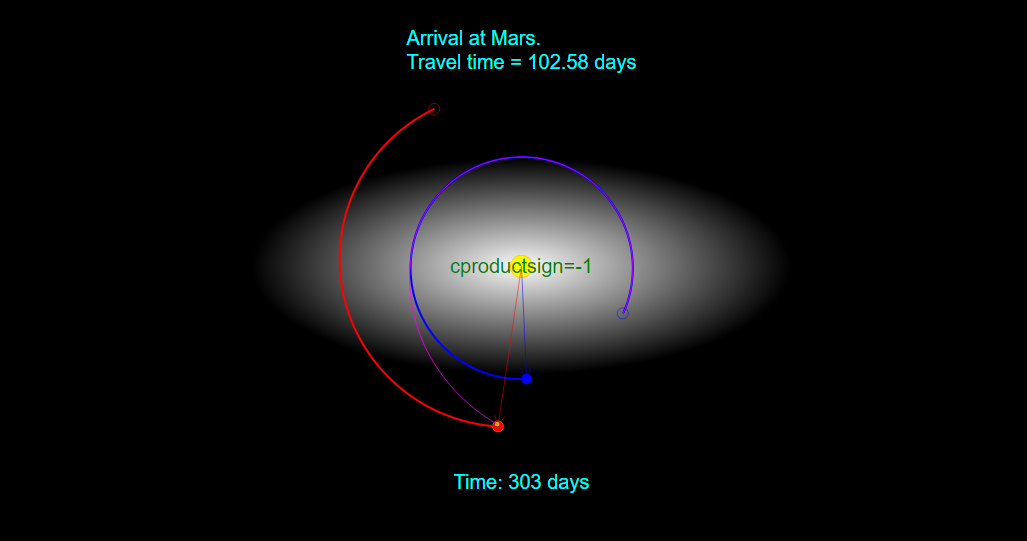
- Exercise 1: Using data from August 29, 2015, the simulation finds that the time between Mars oppositions (the synodic period) is approximately 27.7 months (831 days). The first opposition occurred after 276 days, and the second at Day 1107.
- Exercise 2: Using the Energy Principle and given assumptions about the rocket's speed near Earth's surface and altitude after booster burnout, the calculated speed of the rocket at an altitude of 4.6 Earth radii is approximately 5400 m/s.
- Exercise 3: One successful simulation using initial positions from August 29, 2015, shows a launch on Day 125 (January 01, 2016) resulting in an arrival at Mars on June 25, 2016, with a travel time of 176 days (approximately 6 months). The resource notes that "arrival” is defined as being within 200 Mars diameters. The achieved travel time is compared to historical Mars missions, which range from 128 to 333 days.
- Exercise 4: The resource suggests collecting data from students on their successful orbit parameters, implying that multiple solutions exist.
6. Significance and Educational Value:
This resource offers a hands-on and engaging way for students to learn about fundamental physics principles in the context of a real-world challenge – traveling to Mars. By performing simulations and analyzing the results, students can gain a deeper understanding of:
- Newtonian mechanics and gravitational forces.
- Orbital dynamics and the concept of launch windows.
- The application of the Energy Principle.
- The complexities involved in planning interplanetary missions.
- The power of computational modeling in physics.
The connection to The Martian provides a relatable and motivating entry point for students. The availability in both Easy JavaScript Simulation and GlowScript formats increases accessibility for different learning environments. The inclusion of exercises that guide students through obtaining real-world data from JPL’s Horizons enhances the authenticity and relevance of the learning experience.
7. Areas for Consideration:
- The trial-and-error nature of finding a successful Mars trajectory in Exercise 3 might be time-consuming for some students. Providing more guidance or starting parameters could be beneficial.
- The definition of "arrival" at Mars (within 200 Mars diameters or later 500 Mars diameters as mentioned in the solutions) should be clearly communicated to students.
- The resource acknowledges that the provided template and sample code lack the interactive velocity adjustment feature present in the linked GlowScript simulation ("trip-to-Mars"). Incorporating similar interactive elements could enhance student exploration.
This "PICUP Real World Data NASA Travelling to Mars JavaScript Simulation Applet HTML5" resource provides a valuable tool for physics educators to engage students in the fascinating science behind space exploration.
Journey to Mars: A Study Guide
Quiz
- What are the two main factors of Mars exploration explored by the PICUP activity?
- According to the text, why is the relative positioning of Earth and Mars important for planning a Mars mission?
- What is the synodic period in the context of Earth and Mars orbits, and what astronomical event is related to it?
- Why does the simulation of the rocket's journey to Mars begin after the boosters have burned out and the rocket is sufficiently far from Earth?
- Explain how students can use JPL's Horizons web interface in Exercise 1, and what specific data should they obtain.
- In Exercise 2, what key assumptions are made to calculate the initial speed of the rocket at a certain distance from Earth using the Energy Principle?
- What is the typical travel time for NASA's Mars missions according to the provided text, and how does this compare to the Mayflower's journey across the Atlantic?
- In Exercise 3, what crucial point is made regarding the initial velocity of the rocket in the simulation compared to its velocity relative to Earth at launch?
- What three gravitational forces are considered to be acting on the rocket during its journey to Mars in the simulation?
- How is "arrival at Mars" defined in the context of the simulation results provided in Exercise 3?
Quiz Answer Key
- The two main factors explored are the time between possible launches to Mars, which depends on the relative positions of Earth and Mars, and the time required for the rocket to travel to Mars after leaving Earth.
- The relative positioning of Earth and Mars is crucial because it determines the "ideal" time to launch a rocket to ensure it can intercept Mars efficiently, minimizing travel time and fuel consumption.
- The synodic period is the time it takes for the relative positions of Earth and Mars to repeat. It is related to Mars opposition, which is when Earth passes between Mars and the Sun.
- The simulation focuses on the gravitational forces acting on the rocket during its interplanetary travel, so it begins after the period when thrust from the boosters is the dominant force and the rocket has escaped Earth's immediate vicinity.
- Students should change the Ephemeris Type to "Vector Table" on JPL's Horizons interface and generate ephemerides for both Mars and Earth to record their initial position and velocity vectors in Cartesian coordinates for a chosen date.
- The key assumptions include that the boosters have burned out at a specific altitude (4.6 Earth radii), the rocket achieved 11.5 km/s near Earth's surface, and that the rocket's interactions with the Sun and Mars are negligible during this phase.
- The average travel time for NASA's Mars missions is approximately 225 days, or eight months. This is about four times longer than the Mayflower's journey, which took just over two months.
- The initial velocity of the rocket is specified relative to Earth, but the simulation requires the velocity to be relative to the Sun. Therefore, the velocity of Earth relative to the Sun must be added to the rocket's velocity relative to Earth.
- The three gravitational forces acting on the rocket in the simulation are the force due to the Sun, the force due to Earth, and the force due to Mars.
- In the provided simulation result, "arrival at Mars" is defined as the rocket being within 200 Mars diameters of the planet.
Essay Format Questions
- Discuss the challenges involved in determining the optimal launch window for a Mars mission, explaining the significance of the synodic period and Mars opposition.
- Explain how the Energy Principle is applied to determine the initial speed requirements for a rocket to escape Earth's gravity and reach a specified altitude for a Mars mission. What are the limitations of this approach?
- Describe the process of simulating a Mars mission, highlighting the key assumptions made and the gravitational forces that must be considered to accurately model the trajectory of the spacecraft.
- Analyze the trial-and-error process involved in finding the correct launch day and initial velocity direction for a rocket to reach Mars in the simulation. What factors make this a complex problem?
- Compare and contrast the simulated Mars mission travel times with historical data from actual Mars missions. What factors might account for any differences observed?
Glossary of Key Terms
- Cartesian Coordinates: A system of coordinates that specifies each point uniquely in a plane by a pair of numerical coordinates, which are the signed distances to the point from two fixed perpendicular oriented lines, measured in the same unit of length. In three dimensions, three coordinates are used.
- Euler-Cromer Method: A numerical method used to solve ordinary differential equations, often employed in physics simulations for its stability in cases involving oscillatory motion, like orbital mechanics.
- Energy Principle: A fundamental principle in physics stating that the total energy of an isolated system remains constant over time. It can be used to analyze changes in kinetic and potential energy.
- Escape Speed: The minimum speed needed for a free, non-propelled object to achieve an infinite distance from a massive body, i.e., to escape its gravitational field. For Earth, it is approximately 11 km/s.
- Geosynchronous Orbit: An orbit around Earth of a satellite with an orbital period that matches Earth's rotational period, appearing stationary when viewed from the ground.
- GlowScript: A web-based 3D graphics environment based on VPython, often used for creating physics simulations that can be run in a web browser.
- Gravity: A fundamental force of nature by which all things with mass or energy—including planets, stars, galaxies, and even light—are brought toward one another.
- Initial Conditions: The set of values for the position and velocity (and sometimes other variables) of a system at the beginning of a simulation or a physical process, which are necessary to determine the system's subsequent evolution.
- JPL's Horizons: An online system provided by NASA's Jet Propulsion Laboratory that can be used to generate ephemerides, which are tables of positions of celestial bodies over time, along with their velocities and other data.
- Mars Opposition: The configuration when Earth passes directly between the Sun and Mars. This occurs approximately every 26 months and is often considered a favorable time to launch missions to Mars due to the closer proximity of the two planets.
- Newton's Second Law of Motion: States that the acceleration of an object is directly proportional to the net force acting on the object, is in the same direction as the net force, and is inversely proportional to the mass of the object (F=ma).
- Newton's Law of Gravitation: States that every particle attracts every other particle in the universe with a force that is directly proportional to the product of their masses and inversely proportional to the square of the distance between their centers.
- Orbit: The gravitationally curved path of an object around a point in space, for example, the orbit of a planet around a star.
- Synodic Period: The time interval between two successive similar alignments of three celestial bodies in their orbits, such as the time between two Mars oppositions as viewed from Earth.
- Velocity Vector: A vector quantity that expresses both the speed and the direction of motion of an object.
Sample Learning Goals
[text]
For Teachers
Travelling to Mars JavaScript Simulation Applet HTML5
Instructions
Control Panel





Play/Pause and Reset Buttons

Research
[text]
Video
[text]
Version:
- https://www.compadre.org/PICUP/exercises/exercise.cfm?I=128&A=marsmission
- http://weelookang.blogspot.com/2018/05/travelling-to-mars-javascript.html
- http://www.glowscript.org/#/user/lookang/folder/Public/program/PICUPmarsmissionexercise1
- http://www.glowscript.org/#/user/lookang/folder/Public/program/PICUPmarsmissionexercise234
Other Resources
Frequently Asked Questions: Travelling to Mars Simulation
- What is the primary goal of this simulation activity? This activity aims to explore the complexities of a mission to Mars, specifically focusing on two key aspects: determining the optimal time intervals for launching a rocket from Earth to Mars and calculating the duration of the interplanetary journey once the rocket has left Earth's vicinity. It allows users to investigate the orbital mechanics involved in such a mission.
- What key physics concepts are involved in simulating a trip to Mars? The simulation heavily relies on Newtonian mechanics, particularly Newton's Law of Gravitation to model the forces between the Sun, Earth, Mars, and the rocket. It also utilizes Newton's Second Law to compute the orbits of the planets and the rocket under these gravitational forces. The Energy Principle is applied to determine the initial speed requirements for the rocket to escape Earth's gravity.
- Why is there a waiting period of approximately 26 months between potential launch windows to Mars? This waiting period is due to the synodic period of Earth and Mars. A successful launch requires the planets to be in a specific relative alignment to minimize travel time and fuel consumption. This favorable alignment, often referred to as a Mars opposition (where Earth passes between the Sun and Mars), occurs roughly every 26 months. The simulation allows users to determine this period by observing the repeating relative positions of Earth and Mars in their orbits around the Sun.
- How does the simulation determine the orbits of Earth and Mars? The simulation models the orbits of Earth and Mars by calculating the gravitational force exerted by the Sun on each planet. It neglects the relatively smaller gravitational forces between Earth and Mars. By using initial position and velocity data (which can be obtained from JPL's Horizons web interface) and applying Newton's Second Law over small time steps (often using the Euler-Cromer method), the simulation iteratively updates the planets' velocities and positions, thus tracing their orbital paths.
- What are the initial conditions considered for launching the rocket in the simulation? The simulation simplifies the initial launch phase by considering the rocket after its boosters have burned out and it is sufficiently far from Earth (at an altitude of approximately 4.6 Earth radii, or 5.6 Earth radii from the center). It sets an initial velocity for the rocket relative to Earth (which then needs to be converted to a velocity relative to the Sun for the simulation) and allows users to experiment with the launch day and direction to find a trajectory that reaches Mars.
- What forces are considered to be acting on the rocket during its journey to Mars in the simulation? Once the simulation of the rocket's interplanetary travel begins, it considers the gravitational forces exerted by the Sun, Earth, and Mars on the rocket. The effects of the rocket's thrusters or any mid-course corrections are not modeled in this simplified simulation. The dominant force for most of the journey is the Sun's gravity.
- How does the simulation define "arrival" at Mars? What is a typical travel time to Mars based on the simulation and real-world missions? The simulation defines "arrival" at Mars as the rocket getting within a certain distance of Mars (in the provided code, this is set to 500 Mars diameters). The simulation results indicate a possible travel time of around 176 days (approximately 6 months) for a successful trajectory starting on Day 125 after the initial date. Real-world Mars missions have experienced travel times ranging from about 128 to over 300 days, with an average of around 225 days (8 months), depending on the specific trajectory and mission objectives.
- What is the role of trial and error in using this simulation to plan a Mars mission? Finding the correct launch day and initial velocity direction for the rocket to reach Mars in the simulation requires significant trial and error. Users can adjust these parameters and rerun the simulation to observe the resulting trajectory. By analyzing why certain attempts fail, users can iteratively refine their guesses for the launch conditions to eventually achieve a successful transfer orbit to Mars. The simulation provides a hands-on way to understand the sensitivity of interplanetary trajectories to initial conditions.