
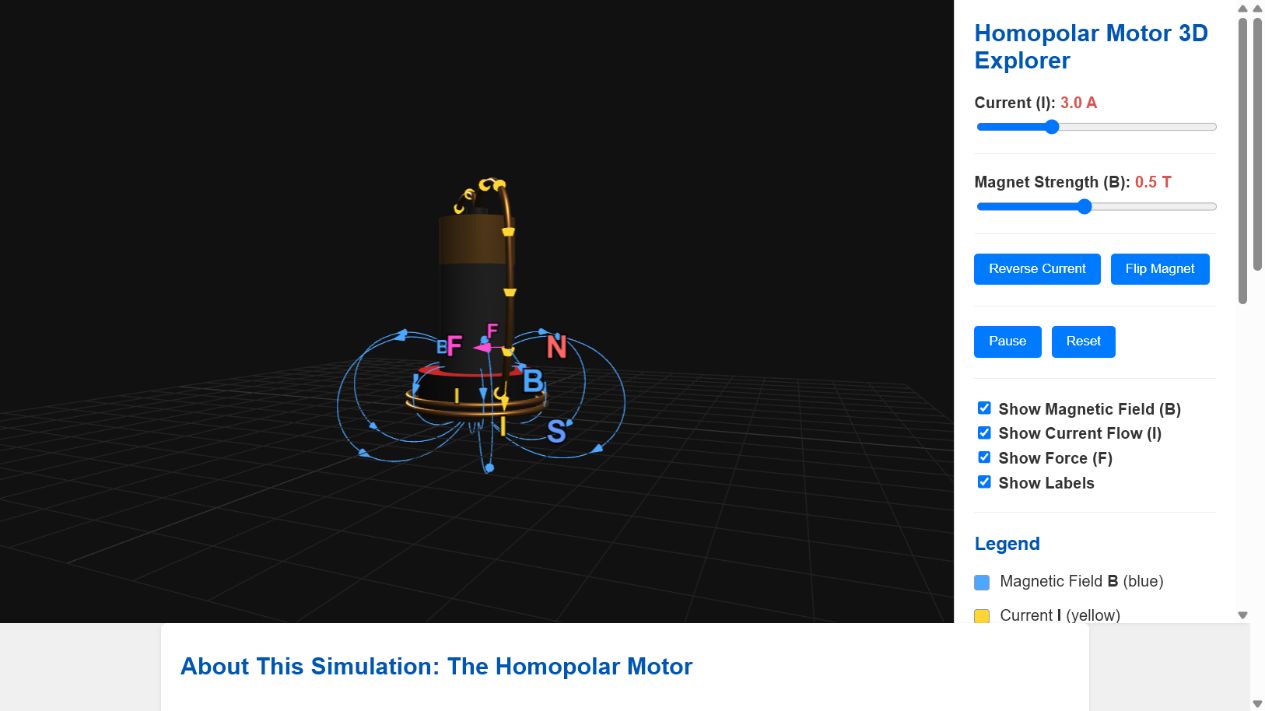
Homopolar Motor 3D Explorer is an alternate, orbitable model created using Claude Fable 5. It makes the magnet's closed field loops, the conventional current path and the tangential magnetic force visible around the classic battery–magnet–wire motor.
Students can reverse the current, flip the magnet, change current and field strength, pause the dynamics and compare the three-dimensional B–I–F relationship with the observed rotation.
Resource type: Claude Fable 5 HTML5 3D simulation, downloadable ZIP package and guided electromagnetism inquiry
Topic: Homopolar motor, motor effect, magnetic field, current, force, torque, rotational inertia and friction
Run the 3D explorer Download ZIP package Read the blog post Find it in the digital library
From demonstration to investigable model
The physical homopolar motor is built from only a battery, a conducting magnet and a shaped copper wire. Once the circuit closes, current passes through a region where the magnet's field has a strong radial component. The resulting magnetic force is tangential, so it creates a torque about the battery's axis.
The real apparatus can spin before students have identified the current path or the relevant field direction. The 3D explorer lets them pause, orbit and isolate the representations before testing how the motion changes.
Seeing B, I and F together
- Magnetic field B: blue closed loops show the global field leaving the north pole and returning to the south pole.
- Current I: yellow moving markers trace conventional current along both wire arms and through the conducting magnet.
- Force F: magenta vectors show the tangential force obtained from the local current and field directions.
For perpendicular current and field directions, the force magnitude is F = IBL. The force direction follows the vector relationship between I and B, while conductor length L scales the magnitude. Because the force acts at a distance from the axis, it produces torque.
Dynamics beyond the force arrows
The model includes a driving magnetic torque and an opposing frictional torque. The wire accelerates and approaches a steady angular speed when those effects balance. Increasing current or magnetic-field strength increases the driving force. Setting current to zero removes the driving torque, but rotational inertia lets the wire coast briefly before friction stops it.
Suggested investigation
- Pause the motor and trace the complete circuit.
- Hide I and F, then follow several B-field loops from north to south.
- Restore I and F and use the local vector directions to predict the force.
- Reverse only the current and compare the new rotation direction.
- Flip only the magnet, then reverse both current and magnet polarity.
- Set current to zero and explain the gradual stopping motion.
Five questions for learners
- Why does broken electrical contact remove the driving torque?
- How does a local B arrow relate to the complete field line passing through that point?
- Why does reversing either I or B reverse F, while reversing both preserves F?
- Why does the rotating wire coast when the current becomes zero?
- Why does a homopolar motor not require a split-ring commutator?
Two complementary homopolar-motor models
This Fable version is published separately from the Homopolar Motor Lab. Their different interfaces and field representations can support a useful comparison: which model makes it easiest to trace the circuit, interpret the global field or determine the force direction?
Credits and open learning
Made by lookang and created using Claude Fable 5 for Open Educational Resources / Open Source Physics @ Singapore. The physical concept was informed by the JavaLab homopolar motor explanation; no source code or page layout was copied.
Download the complete ZIP package for offline use, classroom sharing or adaptation. Explore more resources at iwant2study.org and in the OSPSG Electromagnetism collection.