

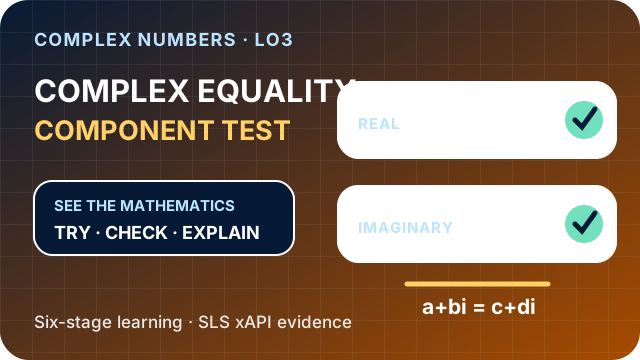
Complex Equality Component Balance develops Equality of complex numbers through six visual, misconception-first stages.
The activity turns equality from a procedural statement into a two-channel comparison: real parts must match and imaginary parts must match. Learners see exactly which component fails and receive targeted remediation instead of a generic incorrect message.
Learning objective: Equality of complex numbers
Resource type: Accessible HTML5 mathematics interactive, teaching guide and SLS xAPI package
Launch interactive Teaching guide Download SLS xAPI ZIP
Why this representation matters
The activity turns equality from a procedural statement into a two-channel comparison: real parts must match and imaginary parts must match. Learners see exactly which component fails and receive targeted remediation instead of a generic incorrect message.
Six-stage learning journey
- Match components: When does a + bi = c + di?
- Use conjugacy: If z = z*, what can you conclude?
- Recover coefficients: 1 + 2i is a root of 2z² + pz + q = 0, where p,q are real. Find p and q.
- Square roots: Solve z² = 3 + 4i.
- Cube roots: Which set contains all roots of z³ = −8?
- Solve a system: Solve z + iw − 1 + i = 0 and 3z + 2w* − 4i = 0.
The AI learning-design prompt
Design a real-versus-imaginary component comparator. Require separate evidence for both components, visual alignment of equal parts, equations with unknowns, misconception-specific feedback, and a final generalisation that two complex numbers are equal exactly when both corresponding components are equal.
The AI read Liang Soon's Word document for mathematical intent, identified likely misconceptions, and converted a static question set into a sequence in which learners inspect, attempt, receive visual feedback, open a tutorial and retry.
How a teacher can use it
Have students cover one component at a time and explain why a match in only the real or only the imaginary part is insufficient.
- Use the first two stages as a diagnostic before formal instruction.
- Ask students to describe the visual change before writing the symbolic step.
- Use the misconception and retry trail as evidence of self-correction.
- Upload the accompanying ZIP to SLS when scored xAPI evidence is required.
What the xAPI package contributes
The supplied xAPI wrapper, integration script and launch contract were preserved. The redesigned mathematics experience is the payload; the proven wrapper connects it to SLS launch, scoring and semantic learning evidence.
Keywords: Mathematics, Complex Numbers, AI Generated, SLS, Equality