

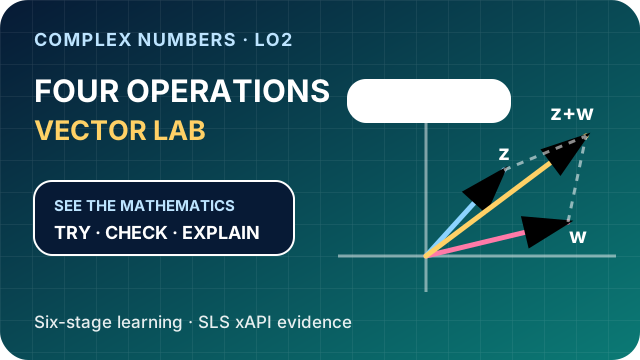
Complex Arithmetic Vector Lab develops Four operations of complex numbers through six visual, misconception-first stages.
Addition, subtraction, multiplication and division are coordinated across symbolic steps and the Argand plane. The visual model lets learners see when an operation is component-wise, when multiplication mixes components, and why division needs a conjugate.
Learning objective: Four operations of complex numbers
Resource type: Accessible HTML5 mathematics interactive, teaching guide and SLS xAPI package
Launch interactive Teaching guide Download SLS xAPI ZIP
Why this representation matters
Addition, subtraction, multiplication and division are coordinated across symbolic steps and the Argand plane. The visual model lets learners see when an operation is component-wise, when multiplication mixes components, and why division needs a conjugate.
Six-stage learning journey
- Add: Find (2 + 3i) + (−5 + i).
- Subtract: Find (−2 + 3i) − (5 − i).
- Multiply: Find (1 + 2i)(5 + 4i).
- Divide: Write (1 − 2i)/(3 + 4i) in a + bi form.
- Invert: Find 1/(3 + 4i).
- Verify: Is (−3 + √7 i)/2 a root of z² + 3z + 4 = 0?
The AI learning-design prompt
Coordinate every symbolic operation with a visual representation. Include exact arithmetic, a vector model for addition and subtraction, area/component reasoning for multiplication, conjugate rationalisation for division, progressive hints, and error feedback tied to sign and i-squared misconceptions.
The AI read Liang Soon's Word document for mathematical intent, identified likely misconceptions, and converted a static question set into a sequence in which learners inspect, attempt, receive visual feedback, open a tutorial and retry.
How a teacher can use it
Before calculation, ask learners to predict the quadrant and approximate location of the answer; use any mismatch to discuss signs and structure.
- Use the first two stages as a diagnostic before formal instruction.
- Ask students to describe the visual change before writing the symbolic step.
- Use the misconception and retry trail as evidence of self-correction.
- Upload the accompanying ZIP to SLS when scored xAPI evidence is required.
What the xAPI package contributes
The supplied xAPI wrapper, integration script and launch contract were preserved. The redesigned mathematics experience is the payload; the proven wrapper connects it to SLS launch, scoring and semantic learning evidence.
Keywords: Mathematics, Complex Numbers, AI Generated, SLS, Complex Arithmetic