
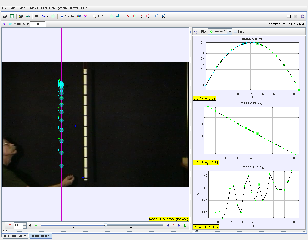
Research digest: This paper is a classroom case for helping beginning physics students connect a real video of vertical motion with displacement-time and velocity-time representations. The useful classroom idea is not merely to show a video, but to let students measure, fit, and then model the motion so that acceleration due to gravity becomes an evidence-based claim.
Classroom use: Use a short toss-up or free-fall clip. Ask students to track the object, inspect the velocity-time graph, and explain why the slope stays nearly constant even though the direction of velocity changes.
Paper: arXiv:1501.02858
Authors: Loo Kang Wee, Kim Kia Tan, Tze Kwang Leong, Ching Tan
Publication: 2015 Phys. Educ. 50 436
Theme: Tracker video analysis for toss-up and free-fall motion
What teachers can take from this
This paper is a classroom case for helping beginning physics students connect a real video of vertical motion with displacement-time and velocity-time representations. The useful classroom idea is not merely to show a video, but to let students measure, fit, and then model the motion so that acceleration due to gravity becomes an evidence-based claim.
Use it tomorrow
Use a short toss-up or free-fall clip. Ask students to track the object, inspect the velocity-time graph, and explain why the slope stays nearly constant even though the direction of velocity changes.
Pedagogical move
After analysis, ask students to build or compare a simple dynamic particle model. This shifts the task from reading a graph to explaining why the graph has that shape.
Good discussion prompts
- What evidence does the model, video, or activity make visible?
- Which variable should students change first, and what should they keep constant?
- What claim can students make from the evidence, and what limitation should they acknowledge?