

Argand Modulus and Argument Observatory develops Representation of complex numbers in the Argand diagram, finding the modulus and argument of a complex number through six visual, misconception-first stages.
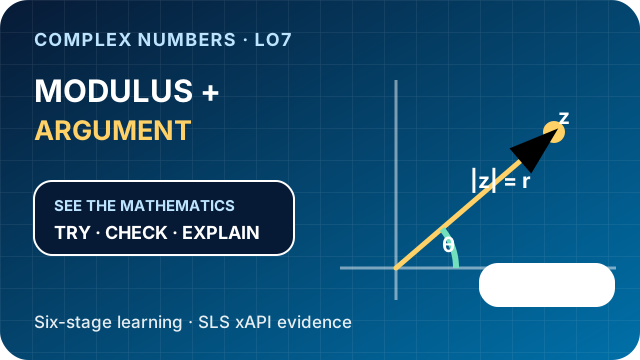
Modulus and argument are learned as measurable geometric quantities attached to a point, not as disconnected formulas. Dragging, radius and angle cues coordinate Cartesian and polar descriptions while preserving exact values.
Learning objective: Representation of complex numbers in the Argand diagram, finding the modulus and argument of a complex number
Resource type: Accessible HTML5 mathematics interactive, teaching guide and SLS xAPI package
Launch interactive Teaching guide Download SLS xAPI ZIP
Why this representation matters
Modulus and argument are learned as measurable geometric quantities attached to a point, not as disconnected formulas. Dragging, radius and angle cues coordinate Cartesian and polar descriptions while preserving exact values.
Six-stage learning journey
- Plot: Place z = 2 + 2i on the Argand plane.
- Find modulus: Find |−3 − √3 i|.
- Find argument: Find the principal argument of 2 + 2i.
- Compare distances: Which complex number is closest to the origin?
- Connect conjugacy: For nonzero z,w with principal arguments, |z|=|w| and arg z=−arg w. What follows?
- Reconstruct: A complex number has modulus 4 and principal argument 2π/3. Which Cartesian form is correct?
The AI learning-design prompt
Create an accessible Argand observatory with tap, drag and keyboard placement. Make modulus a radius, argument an oriented principal angle, require quadrant reasoning before inverse tangent, compare distances using squared moduli, and reconstruct exact Cartesian form from polar data.
The AI read Liang Soon's Word document for mathematical intent, identified likely misconceptions, and converted a static question set into a sequence in which learners inspect, attempt, receive visual feedback, open a tutorial and retry.
How a teacher can use it
Ask students to estimate radius and angle visually before calculating, then explain any difference between the estimate and exact value.
- Use the first two stages as a diagnostic before formal instruction.
- Ask students to describe the visual change before writing the symbolic step.
- Use the misconception and retry trail as evidence of self-correction.
- Upload the accompanying ZIP to SLS when scored xAPI evidence is required.
What the xAPI package contributes
The supplied xAPI wrapper, integration script and launch contract were preserved. The redesigned mathematics experience is the payload; the proven wrapper connects it to SLS launch, scoring and semantic learning evidence.
Keywords: Mathematics, Complex Numbers, AI Generated, SLS, Argand Diagram