







About
Developed by E. Behringer
Easy JavaScript Simulation by Fremont Teng and Loo Kang Wee
This set of exercises guides the student in exploring primary and secondary rainbows. It requires the student to generate, observe, and describe plots of the deflection angles for light of different wavelengths and identify rainbow angles for different values of the relative index of refraction.
| Subject Area | Waves & Optics |
|---|---|
| Levels | First Year and Beyond the First Year |
| Available Implementation | Python & Easy JavaScript Simulation |
| Learning Objectives |
Students who complete this set of exercises will be able to
|
| Time to Complete | 120 min |
This set of exercises may be used in an introductory course that covers optics or in an upper-level optics course. The first three computational exercises are not demanding, but collectively provide an opportunity to deduce physical consequences (e.g., why is it that the primary and secondary rainbows are bright in particular directions). The last exercise is intended purely as a crude, ‘zeroeth order’ estimate of the irradiance as a function of deflection angle, purposefully neglecting polarization effects. Additional computational exercises have been described by D.S. Amundsen et al., Am. J. Phys. 77 (9), 795-798 (2009). An experimental apparatus to explore rainbows up to the 6th order has been described by G. Casini and A. Covello, Am. J. Phys. 80 (11), 1027-1034 (2012).
For Exercises 3 and 4, the theoretical concepts required are the Law of Refraction and the Law of Reflection, which are standard topics in introductory courses and are usually revisited in intermediate or advanced optics courses.
For Exercise 5, the crude model is nothing more than summing the irradiances associated with different rays, which implicitly assumes that the rays are incoherent with one another. Depending on the course, this can be contrasted with the ideas underlying the derivation of far field diffraction patterns - namely, that one works with the electric fields and carefully accounts for the relative phases of contributions from different parts of an extended source.
EXERCISE 1: OBTAIN AND USE INFORMATION FROM PEER-REVIEWED LITERATURE
Water and air are the two materials involved with producing rainbows we may see in the sky after a thunderstorm. To accurately predict where rainbows will appear, we need to have accurate information about the refractive indices of water and air.
(a) Obtain a copy of “Models for the wavelength dependence of the index of refraction of water”, Applied Optics 36 (16), 3785-3787 (1997) by Paul D.T. Huibers, and use Eq. (3) of that paper to generate a plot of the refractive index of water as a function of wavelength in the range from 400 to 650 nm.
(b)
Obtain a copy of “Refractive index of air: new equations for the visible
and near infrared”, Applied Optics 35(9),
1566-1573 (1996) by Philip E. Ciddor, and use Eq. (1) of that paper to
generate a plot of
Which material has the larger change in refractive index over the wavelength range from 400 to 650 nm? Calculate the ratio of the larger change to the refractive index of the material for a wavelength of 400 nm, and comment on the magnitude of the ratio.
EXERCISE 2: DEFLECTION ANGLE FOR A LIGHT RAY ENTERING A SPHERICAL RAINDROP
Assume
that a light ray incident on a spherical raindrop at an angle
 `
`
Show
that if
The
deflection angle
EXERCISE 3: COMPUTE THE DEFLECTION ANGLE VERSUS INCIDENT ANGLE
Generate
a plot of the deflection angle
Near
the minimum of the deflection function (that is, the
EXERCISE 4: WHERE IS THE SECONDARY (DOUBLE) RAINBOW?
Repeat the computation of Exercise 3, but now assume that the ray undergoes two internal reflections within the raindrop. In this case, show that the deflection angle is given by
and plot the deflection angle versus the incident angle for rays of wavelength 400 nm and 650 nm. The two curves should have minima that are close to each other, but not identical. What are the values of the incident angle corresponding to these two minima? Assuming that these minima correspond to the rainbow direction, what direction do you have to look relative to the horizontal to see the bright red band of the secondary rainbow? Can a ground based observer see these rays? Do the rays that produce the secondary rainbow enter the top of the raindrop? What direction do you have to look relative to the horizontal to see the bright violet band? Which band appears higher in the sky?
Near
the minimum of the deflection function (that is, the
EXERCISE 5: CRUDE ESTIMATE OF THE IRRADIANCE VERSUS DEFLECTION ANGLE FOR A SINGLE WAVELENGTH: PRIMARY RAINBOW
Assume
that the each outgoing ray produces an irradiance that is equal to
EXERCISE 5: CRUDE ESTIMATE OF THE IRRADIANCE VERSUS DEFLECTION ANGLE FOR A SINGLE WAVELENGTH: PRIMARY RAINBOW
Assume that the each outgoing ray produces an irradiance that is equal to where here the angles are assumed to be in degrees and the implied width of this distribution is . (For simplicity, we neglect the loss of intensity during refraction and internal reflection. This is a huge oversimplification, but it allows us to focus on adding up contributions from each ray.) Sum up the contributions from rays uniformly distributed over the scaled impact parameter to compute the overall irradiance as a function of deflection angle for light of wavelength 400 nm. Plot the resulting irradiance distribution versus deflection angle for a single wavelength. How does this plot help explain why the rainbow is bright?
#
# Rainbows_Exercise_5.py
#
# Plot the irradiance as a function of
# deflection angle for rays undergoing
# a single internal reflection,
# assuming a spherical water drop
# and two wavelengths.
#
# Here, as a 'zeroeth' approximation,
# the Fresnel coefficients are NOT taken into account.
#
# The refractive index of water is taken from
# Eq. 3 of P.D.T Huibers, Applied Optics,
# Vol. 36, No. 16, pp. 3785-3787 (1997).
#
# The refractive index of air is taken from
# Eq. 1 of P.E. Ciddor, Applied Optics,
# Vol. 35, No. 9, pp. 1566-1573 (1996).
#
# Written by:
#
# Ernest R. Behringer
# Department of Physics and Astronomy
# Eastern Michigan University
# Ypsilanti, MI 48197
# (734) 487-8799
# This email address is being protected from spambots. You need JavaScript enabled to view it.
#
# 20160109 by ERB
#
from __future__ import print_function
from pylab import figure,plot,xlim,xlabel,ylim,ylabel,grid,legend,title,show
from math import pi,asin
from numpy import linspace,arcsin,sin,exp,zeros,argmin,argmax
# Define the index of refraction function for water
def water_index(wavelength):
n_H2O = 1.31279 + 15.762/wavelength - 4382.0/(wavelength**2) + 1.1455e6/(wavelength**3)
return(n_H2O)
# Define the index of refraction function for air
# Note: wavelength is supposed to be in micrometers
def air_index_minus_one(wavelength):
term1 = 0.05792105/(238.0185 - 1.0e6/(wavelength**2))
term2 = 0.00167917/(57.362 - 1.0e6/(wavelength**2))
return(term1+term2)
# Inputs
wavelength_r = 650 # vacuum wavelength in nm ("red")
wavelength_v = 400 # vacuum wavelength in nm ("violet")
n_r = water_index(wavelength_r) # refractive index of water at wavelength_r
n_v = water_index(wavelength_v) # refractive index of water at wavelength_v
npts = 801 # the number of scaled impact parameters, i.e., rays
width = 1.0 # angular width of ray [deg]
ndetpts = 501 # the number of detector points
n_ar = 1.0 + air_index_minus_one(wavelength_r) # refractive index of air at wavelength_r
n_av = 1.0 + air_index_minus_one(wavelength_v) # refractive index of air at wavelength_v
# Generate the array of uniformly distributed scaled impact parameters
scaled_b = linspace(0.0,1.0,npts)
# Generate the corresponding array of incident angle values [rad]
theta_i = arcsin(scaled_b)
# Generate the corresponding array of incident angle values [deg]
theta_i_deg = 180.0*theta_i/pi
# Set up the arrays of deflection angles
theta_r = zeros(npts)
theta_v = zeros(npts)
# Calculate the refraction angle for each incident angle
# and for red and for violet light
for j in range(0,npts):
theta_r[j] = asin((n_ar/n_r)*sin(theta_i[j]))
theta_v[j] = asin((n_av/n_v)*sin(theta_i[j]))
# Calculate the deflection angle for each incident angle for red light
theta1r = 2.0*(theta_i - theta_r) + 1.0*(pi - 2.0*theta_r) # First deflection function
theta1r_deg = theta1r*180.0/pi
# Calculate the deflection angle for each incident angle for violet light
theta1v = 2.0*(theta_i - theta_v) + 1.0*(pi - 2.0*theta_v) # First deflection function
theta1v_deg = theta1v*180.0/pi
print("The primary rainbow deflection angle for red light is ",min(theta1r_deg))
# The index of this value is
index_r = argmin(theta1r_deg)
print("This primary rainbow deflection angle for red light corresponds to")
print("an incident angle of ",theta_i_deg[index_r]," deg.")
print("The red band of the primary rainbow appears at ",180.0-min(theta1r_deg)," above the horizontal.")
print(" ")
print("The primary rainbow deflection angle for violet light is ",min(theta1v_deg))
# The index of this value is
index_v = argmin(theta1v_deg)
print("This primary rainbow deflection angle for violet light corresponds to")
print("an incident angle of ",theta_i_deg[index_v]," deg.")
print("The violet band of the primary rainbow appears at ",180.0-min(theta1v_deg)," above the horizontal.")
print(" ")
# Set up the array of irradiance versus deflection angle
deflection_angles_deg = linspace(130,180,ndetpts)
irradiance_r = zeros(ndetpts)
irradiance_v = zeros(ndetpts)
# Accummulate irradiance from each ray
# that corresponds to one impact parameter
for i in range(0,ndetpts):
# for every detection angle...
for j in range(0,npts):
# accumulate the irradiance into a particular angle from each ray
irradiance_r[i] = irradiance_r[i] + exp(-((deflection_angles_deg[i] - theta1r_deg[j])/width)**2)
irradiance_v[i] = irradiance_v[i] + exp(-((deflection_angles_deg[i] - theta1v_deg[j])/width)**2)
# Scale the intensities
scaled_irradiance_r = irradiance_r/max(irradiance_r)
scaled_irradiance_v = irradiance_v/max(irradiance_v)
# The index of this value at which the maximum scaled irradiance occurs is
index_r_irradiance = argmax(scaled_irradiance_r)
print("The detection angle at which ")
print("the red irradiance is maximum = ",deflection_angles_deg[index_r_irradiance]," deg.")
print("The maximum appears ",180.0-deflection_angles_deg[index_r_irradiance], " deg. above the horizontal.")
print(" ")
# The index of this value is
index_v_irradiance = argmax(scaled_irradiance_v)
print("The detection angle at which ")
print("the violet irradiance is maximum = ",deflection_angles_deg[index_v_irradiance]," deg.")
print("The maximum appears ",180.0-deflection_angles_deg[index_v_irradiance], " deg. above the horizontal.")
print(" ")
#----------------------------------------------------------------------
# Start a new figure. This will be a plot of the
# scaled irradiance versus deflection angles
figure()
# Set the limits of the horizontal axis
xlim(130,180)
# Label the horizontal axis
xlabel("Detection angle relative to incident ray \(\\phi\) [deg]", size = 16)
# Set the limits of the vertical axis
ylim(0.0,1.0)
# Label the vertical axis
ylabel("Scaled irradiance \(I/I_{max}\)", size = 16)
# Draw a grid
grid(True)
# Plot the deflection functions
plot(deflection_angles_deg,scaled_irradiance_r,"r-",label="\(\lambda = 650 \\, {\\rm nm}\)")
plot(deflection_angles_deg,scaled_irradiance_v,"b-",label="\(\lambda = 400 \\, {\\rm nm}\)")
# Generate the legend
legend(loc=1)
# Generate the title
title("Crude estimate of irradiance versus deflection angle\n for one internal reflection")
show()
Exercise 1: Obtain and use information from peer-reviewed literature
The plot for the refractive index of water should look like:

 `
`
The plot for the deviation of the refractive index of air from unity should look like:


Exercise 2: Deflection angle for a light ray entering a spherical raindrop
To calculate the deflection angle, one needs to know the refractive index of the air and the water at the particular wavelength and also the angle of incidence of the incoming ray. The laws of refraction and reflection are then applied to obtain the angles of refraction and the angle of reflection for the internal reflection. Students should be able to show that the equalities shown in the figure illustrating the ray/raindrop geometry.
Exercise 3: Compute the deflection angle versus incident angle
The solution for Exercise 3 is:


The
minimum of the deflection function for
Exercise 4: Where is the double (secondary) rainbow?

The
solution for Exercise 4 is:
The
minimum of the deflection function for
Exercise 5: Crude estimate of the irradiance versus deflection angle for a single wavelength: Primary Rainbow

The
solution for Exercise 5 is:
Note
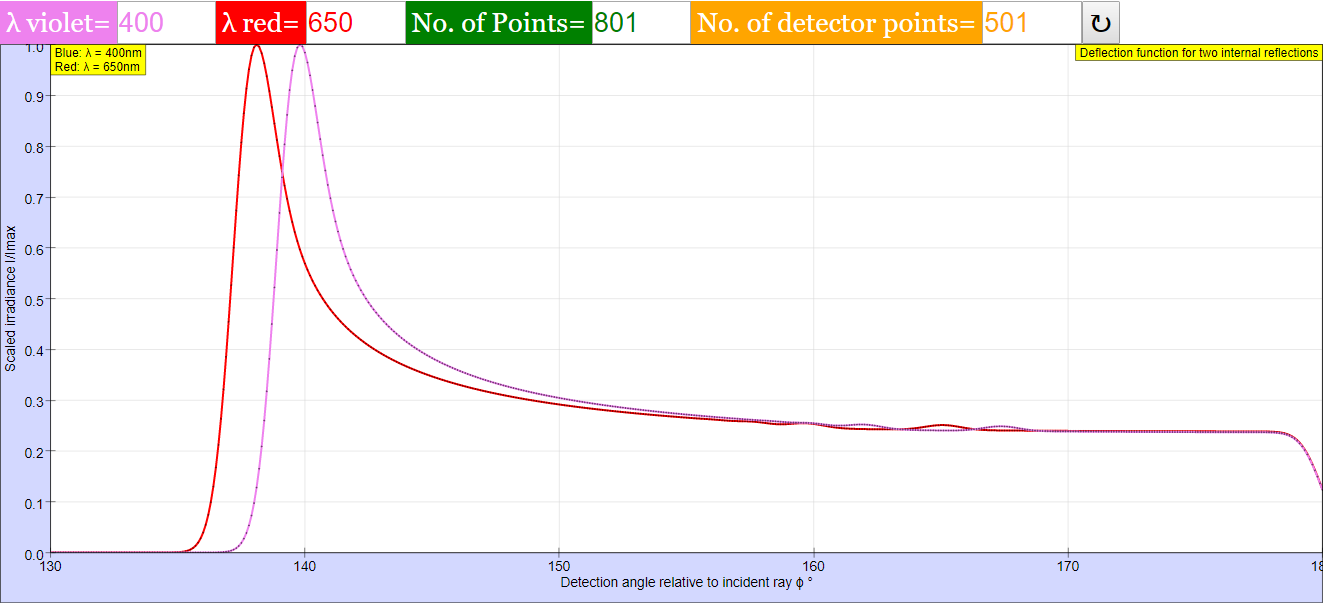
that irradiance is distributed over a large range of detection angles, and that the irradiance has a peak near (but not at) the minimum of the deflection function for these chosen parameters. If we use an angular width smaller than
Most introductory textbooks mention rainbows and the angles at which they can be observed, but do not necessarily explain why rainbows are bright. This set of exercises is intended to show how irradiance “piles up” around the minima of the deflection functions calculated in Exercises 3 and 4.
Translations
| Code | Language | Translator | Run | |
|---|---|---|---|---|
 |
||||
Credits

Fremont Teng; Loo Kang Wee
Simulation Applet HTML5." This resource, developed by E. Behringer using Easy JavaScript Simulation by Fremont Teng and Loo Kang Wee, offers a set of exercises designed to guide students in exploring the physics of primary and secondary rainbows. The exercises involve generating, observing, and describing plots of deflection angles for different wavelengths of light as it interacts with spherical raindrops, and identifying the rainbow angles based on the relative refractive index.
Main Themes and Important Ideas:
- Understanding Rainbow Formation through Optics: The core theme is to provide a computational and interactive approach to understanding how rainbows are formed. This involves applying fundamental principles of optics, specifically the Law of Refraction (Snell's Law) and the Law of Reflection, to the interaction of sunlight with spherical raindrops. The exercises systematically build upon these laws to explain the deflection of light and the resulting angular separation of colors.
- The "About" section explicitly states that the exercises guide students in "exploring primary and secondary rainbows" and require them to "generate, observe, and describe plots of the deflection angles for light of different wavelengths and identify rainbow angles for different values of the relative index of refraction."
- Computational Exploration and Data Analysis: A significant aspect of this resource is the emphasis on computational exercises. Students are expected to use peer-reviewed literature to obtain refractive index data for water and air at different wavelengths and then use this data to generate plots and perform calculations. This fosters skills in data acquisition, analysis, and visualization.
- Learning Objectives include the ability to:
- "obtain and use information from peer-reviewed literature. Plot an equation over a range of values. Analyze and compare plots (Exercises 1 and 2);"
- "write the deflection angle in terms of the relative index of refraction to calculate the deflection angle of rays entering spherical drops (Exercises 3 and 4);"
- "produce and describe graphs of deflection angle versus incident angle for light of different wavelengths (Exercises 3 and 4)."
- Deflection Angle and Rainbow Angles: The exercises focus on the concept of the deflection angle of light rays as they pass through raindrops. The minimum deflection angle for a particular number of internal reflections is identified as the angle at which the rainbow appears brightest for that order. The resource explores how this angle varies with the wavelength of light, leading to the separation of colors.
- Exercise 2 requires students to "Show that ... the deflection angle ... of the light ray is..." for one internal reflection.
- Exercise 3 instructs students to "Generate a plot of the deflection angle ... as a function of incident angle ..." and to "identify rainbow angles for light of different wavelengths."
- Primary and Secondary Rainbows: The resource specifically addresses both primary (one internal reflection) and secondary (two internal reflections) rainbows. Students are guided to understand the differences in their formation, the order of colors, and their relative positions in the sky.
- Exercise 3 focuses on the primary rainbow, while Exercise 4 explicitly asks, "Where is the secondary (double) rainbow?" and provides the formula for the deflection angle with two internal reflections.
- The solutions highlight that for the primary rainbow, "the red band appears above the violet band," while for the secondary rainbow, "the red band ... appears below the violet band," and that the "secondary rainbow appears above the primary rainbow."
- Irradiance and Brightness of Rainbows: Exercise 5 delves into why rainbows appear bright at specific angles. It introduces a simplified model for irradiance as a function of deflection angle and asks students to sum the contributions from multiple rays. The key idea is that near the minimum deflection angle, many rays are deflected in nearly the same direction, leading to an accumulation of irradiance.
- Exercise 5 states, "Assume that the each outgoing ray produces an irradiance that is equal to ... Sum up the contributions from rays uniformly distributed over the scaled impact parameter ... to compute the overall irradiance as a function of deflection angle..."
- The solution to Exercise 5 concludes, "The main result is that irradiance accumulates in the direction specified by the minimum in the deflection function because several rays are deflected into essentially the same direction. This is known as rainbow scattering..."
- Importance of Refractive Index: The exercises emphasize the role of the refractive index of water and air, and how it varies with the wavelength of light. This wavelength dependence is crucial for the dispersion of sunlight into its constituent colors, which is the fundamental phenomenon behind rainbows.
- Exercise 1 explicitly requires students to "Obtain a copy of 'Models for the wavelength dependence of the index of refraction of water' ... and 'Refractive index of air: new equations for the visible and near infrared'..." and to analyze how the refractive index changes with wavelength.
- Limitations and Simplifications: The resource acknowledges that the models used, particularly in Exercise 5 regarding irradiance, involve simplifications. For instance, polarization effects and the loss of intensity during refraction and reflection are neglected to focus on the core principles.
- The introduction to Exercise 5 notes, "(For simplicity, we neglect the loss of intensity during refraction and internal reflection. This is a huge oversimplification, but it allows us to focus on adding up contributions from each ray.)"
Target Audience and Implementation:
The resource is designed for "First Year and Beyond the First Year" university-level physics courses covering "Waves & Optics." The instructor guide suggests that the exercises can be used in introductory or upper-level optics courses. The estimated time to complete the set of exercises is 120 minutes. The availability of Python and Easy JavaScript Simulation implementations offers flexibility for instructors.
Key Exercises and Findings:
- Exercise 1: Focuses on obtaining and using real-world data for the refractive indices of water and air as a function of wavelength. Students compare the change in refractive index for both materials over the visible spectrum.
- Exercise 2: Derives the formula for the deflection angle of a light ray undergoing one internal reflection in a spherical raindrop. It highlights the necessary quantities for this calculation: the refractive indices and the incident angle.
- Exercise 3: Involves computing and plotting the deflection angle versus incident angle for red (650 nm) and violet (400 nm) light experiencing one internal reflection. It identifies the minimum deflection angles and the corresponding rainbow angles for primary rainbows, explaining why the red band appears higher than the violet band.
- Exercise 4: Repeats the computation for two internal reflections (secondary rainbow). It shows that the order of colors is reversed, and the secondary rainbow appears at a larger angle above the horizon than the primary rainbow. It also notes that the rays enter the bottom half of the raindrop.
- Exercise 5: Provides a crude estimate of irradiance versus deflection angle, demonstrating how the brightness of the rainbow arises from the accumulation of light rays near the minimum deflection angle ("rainbow scattering").
Conclusion:
The "PICUP Deflection Function for Two Internal Functions JavaScript Simulation Applet HTML5" provides a valuable open educational resource for students learning about the physics of rainbows. By combining theoretical concepts with computational exercises and interactive simulations, it allows for a deeper understanding of light-matter interaction, refraction, reflection, and the phenomenon of rainbow formation. The resource effectively guides students through the process of understanding why rainbows appear at specific angles, why colors are separated, and why they are brightest in particular directions. The inclusion of both primary and secondary rainbows, along with a discussion of irradiance, offers a comprehensive exploration of this fascinating optical phenomenon.
Rainbow Formation Study Guide
Quiz
- What two primary optical phenomena are responsible for the formation of rainbows within raindrops?
- Explain the concept of the deflection angle of a light ray as it interacts with a spherical raindrop.
- For a primary rainbow, how many internal reflections does a light ray undergo within a raindrop before exiting?
- What is the relationship between the minimum deflection angle for a particular wavelength of light and the angle at which that color of the rainbow is observed?
- Why do different colors of light appear at different angles in a rainbow? What property of light is responsible for this separation?
- In a primary rainbow, what is the order of the colors observed from top to bottom? How does this compare to a secondary rainbow?
- According to Exercise 5, what simplifying assumption is made when calculating the irradiance of outgoing rays from a raindrop? Why is this a simplification?
- What does the analysis of the deflection angle versus incident angle curves reveal about the brightness of rainbows in specific directions?
- For a secondary rainbow, how many internal reflections does a light ray undergo within a raindrop? How does this affect its brightness compared to a primary rainbow?
- What is "rainbow scattering," and in what other types of scattering events is it observed, according to the source material?
Quiz Answer Key
- The two primary optical phenomena responsible for rainbow formation are refraction (when light enters and exits the raindrop, bending due to the change in medium) and reflection (when light internally reflects off the back surface of the raindrop).
- The deflection angle is the angle between the incident direction of a light ray and its final outgoing direction after interacting with the raindrop. It quantifies the total deviation of the light ray's path.
- For a primary rainbow, a light ray undergoes one internal reflection within the raindrop before exiting towards the observer.
- The minimum deflection angle for a specific wavelength corresponds to the angle of maximum intensity for that color in the rainbow. This is because many rays with slightly different incident angles are deflected in nearly the same direction near the minimum.
- Different colors of light appear at different angles due to dispersion, which is the wavelength-dependent nature of the refractive index of water. This causes different wavelengths (colors) to be bent by different amounts during refraction.
- In a primary rainbow, the order of colors from top to bottom is red, orange, yellow, green, blue, indigo, violet. In a secondary rainbow, this order is reversed.
- Exercise 5 assumes that each outgoing ray produces an irradiance given by a Gaussian function and neglects the loss of intensity during refraction and internal reflection. This is a simplification because in reality, the Fresnel coefficients would determine the amount of light reflected and refracted at each interface.
- The analysis shows that near the minimum of the deflection angle curve, many rays with slightly different incident angles are deflected into nearly the same direction. This causes an accumulation of irradiance, resulting in the bright bands of the rainbow.
- For a secondary rainbow, a light ray undergoes two internal reflections within the raindrop. This additional reflection leads to a loss of irradiance, making the secondary rainbow fainter than the primary rainbow.
- Rainbow scattering is the phenomenon where irradiance accumulates in the direction corresponding to the minimum in the deflection function because multiple rays are deflected in essentially the same direction. It is also observed in atomic/molecular collisions and ion collisions with ordered surfaces.
Essay Format Questions
- Discuss the role of the refractive index of water and its wavelength dependence in the formation of primary and secondary rainbows. How do the different refractive indices for red and violet light lead to the observed color separation and the order of colors in each type of rainbow?
- Explain the derivation of the deflection angle formulas for light rays undergoing one and two internal reflections in a spherical raindrop. What are the key optical laws involved, and how do these formulas help predict the angular positions of the primary and secondary rainbows?
- Analyze the concept of minimum deflection angle in the context of rainbow formation. Why does the minimum in the deflection angle versus incident angle curve correspond to the bright bands of a rainbow? How does this relate to the perceived intensity of light at different viewing angles?
- Compare and contrast the formation of primary and secondary rainbows, focusing on the number of internal reflections, the resulting deflection angles, the order of colors observed, and the apparent position of each rainbow relative to the observer and the sun.
- Evaluate the "crude estimate of irradiance" model presented in Exercise 5. What are its strengths and limitations in explaining the brightness profile of a primary rainbow? How might a more sophisticated model, incorporating factors like Fresnel coefficients and interference, provide a more accurate description?
Glossary of Key Terms
- Refraction: The bending of light as it passes from one medium to another with a different refractive index.
- Reflection: The bouncing of light off a surface. In the context of rainbows, it refers to the internal reflection within the raindrop.
- Deflection Angle (δ): The angle between the incident direction of a light ray and its outgoing direction after interacting with a raindrop.
- Incident Angle (θᵢ): The angle between the incoming light ray and the normal (a line perpendicular to the surface) at the point of incidence.
- Refraction Angle (θ<0xE1><0xB5><0xA3>): The angle between the refracted light ray and the normal at the point of refraction.
- Wavelength (λ): The distance between successive crests (or troughs) of a wave. Different wavelengths of visible light correspond to different colors.
- Refractive Index (n): A measure of how much the speed of light is reduced inside a medium compared to its speed in a vacuum. It depends on the wavelength of light and the properties of the medium.
- Dispersion: The phenomenon in which the refractive index of a material varies with the wavelength of light, causing different colors to be refracted at different angles.
- Primary Rainbow: A rainbow formed by light undergoing one internal reflection within raindrops.
- Secondary Rainbow: A fainter rainbow formed by light undergoing two internal reflections within raindrops, with the order of colors reversed compared to the primary rainbow.
- Irradiance (I): The power of electromagnetic radiation per unit area incident on a surface. In this context, it relates to the brightness of the deflected light.
- Impact Parameter (b): The perpendicular distance from the center of a scattering object (like a raindrop) to the initial path of a projectile (like a light ray).
- Rainbow Scattering: The accumulation of irradiance in specific directions corresponding to the minima in the deflection function, resulting in the bright bands of a rainbow.
Sample Learning Goals
[text]
For Teachers
Deflection Function for Two Internal Functions JavaScript Simulation Applet HTML5
Instructions
Control Panel

Toggling Full Screen
Reset Button

Research
[text]
Video
[text]
Version:
- https://www.compadre.org/PICUP/exercises/exercise.cfm?I=129&A=rainbows
- http://weelookang.blogspot.com/2018/06/deflection-function-for-two-internal.html
Other Resources
[text]
end faq
{accordionfaq faqid=accordion4 faqclass="lightnessfaq defaulticon headerbackground headerborder contentbackground contentborder round5"}
Frequently Asked Questions about Rainbow Formation
What are the fundamental optical principles that govern the formation of rainbows?
Rainbows are formed through the refraction and reflection of sunlight within spherical raindrops. When sunlight enters a raindrop, it is first refracted at the air-water interface, causing different wavelengths (colors) of light to bend at slightly different angles due to the varying refractive index of water with wavelength (dispersion). This separated light then reflects off the back surface of the raindrop and undergoes a second refraction as it exits back into the air, further separating the colors.
How does the deflection angle of light relate to the observation of a rainbow?
The deflection angle is the angle between the incident sunlight ray and the outgoing ray after interacting with a raindrop. For a given number of internal reflections within the raindrop, there is a minimum deflection angle. Near this minimum angle, many rays with slightly different incident angles are deflected into almost the same direction. This "piling up" of light rays at the minimum deflection angle results in a region of higher intensity, which we observe as the bright arc of a rainbow.
What is the difference between a primary and a secondary rainbow in terms of light interaction with raindrops?
A primary rainbow is formed when sunlight undergoes one internal reflection inside a raindrop. The order of colors in a primary rainbow is red on the outside and violet on the inside. A secondary rainbow is formed when sunlight undergoes two internal reflections inside a raindrop. This extra reflection reverses the order of the colors, with violet on the outside and red on the inside. The secondary rainbow is also fainter than the primary rainbow due to the additional loss of intensity from the extra reflection.
At what approximate angles relative to the horizon do the primary and secondary rainbows typically appear, and why are they at these angles?
The primary rainbow appears at an angle of approximately 42 degrees away from the anti-solar point (the point directly opposite the sun). The red band is at a slightly lower angle (around 42.4 degrees) and the violet band at a slightly higher angle (around 40.7 degrees). The secondary rainbow appears at a larger angle of approximately 50-53 degrees from the anti-solar point, with the red band at a higher angle (around 50.2 degrees) and the violet band at a lower angle (around 53.3 degrees). These angles correspond to the minima in the deflection angles for light undergoing one and two internal reflections within the raindrops.
Why are different colors observed in a rainbow, and what determines their order?
The different colors in a rainbow are due to the dispersion of sunlight by water. The refractive index of water varies slightly with the wavelength of light, causing different colors to be refracted at slightly different angles. Violet light has a shorter wavelength and is refracted more than red light, which has a longer wavelength. In a primary rainbow (one internal reflection), this differential refraction leads to red light exiting the raindrop at a slightly larger angle than violet light relative to the incident direction, resulting in the red arc appearing on the outside. In a secondary rainbow (two internal reflections), the order is reversed due to the additional reflection.
How does the intensity of light contribute to the visibility and brightness of a rainbow?
The brightness of a rainbow is related to the intensity of the light reaching the observer's eye. The concentration of deflected light rays near the minimum deflection angle leads to a higher intensity in those directions, making the rainbow appear bright. The simulation mentioned suggests a crude model where irradiance from rays with similar deflection angles is summed, resulting in a peak in intensity near the minimum deflection angle. Factors like the size and number of raindrops, and the angle of the sun, also affect the overall intensity of the rainbow.
What role does the observer's position play in seeing a rainbow?
An observer can only see a rainbow if the sun is behind them and the raindrops are in front. The rainbow is not a fixed object in space; it is an optical phenomenon whose appearance depends on the relative positions of the sun, the raindrops, and the observer. Different observers will see slightly different rainbows formed by light interacting with different sets of raindrops.
Can rainbows of higher orders than primary and secondary exist, and what would their characteristics be?
Yes, rainbows of higher orders (three, four, etc., internal reflections) can theoretically exist. However, with each additional internal reflection, some light is refracted out of the raindrop, leading to a significant decrease in intensity. Higher-order rainbows are therefore very faint and much more difficult to observe in nature. They would also appear at different angles and have different color orders compared to the primary and secondary rainbows.