







About
Simple Harmonic Motion
Guiding Questions
- What are the characteristics of periodic motion? How can we study and describe such motion?
- How can circular motion be related to simple harmonic motion (SHM)?
- How do we analyse simple harmonic motion?
Learning Outcomes (LOs)
- describe simple examples of free oscillations.
- investigate the motion of an oscillator using experimental and graphical methods.
- understand and use the terms amplitude, period, frequency and angular frequency.
- recognise and use the equation a = - ω2 x as the defining equation of simple harmonic motion.
- recall and use x= x0 ω sin( ωt )as a solution to the equation a = - ω2 x
- recognise and use v = v0 cos ( ω t ) ,
- describe with graphical illustrations, the changes in displacement, velocity and acceleration during simple harmonic motion.
- describe the interchange between kinetic and potential energy during simple harmonic motion.
- describe practical examples of damped oscillations with particular reference to the effects of the degree of damping and the importance of critical damping in cases such as a car suspension system.
- describe practical examples of forced oscillations and resonance.
- describe graphically how the amplitude of a forced oscillation changes with driving frequency near to the natural frequency of the system, and understand qualitatively the factors which determine the frequency response and sharpness of the resonance
- show an appreciation that there are some circumstances in which resonance is useful and other circumstances in which resonance should be avoided.
Learning Experiences
- Examine representations used in oscillations
- Examine how different graphs are used to represent SHM. Draw links between the different graphs highlighting the positive and negative values and their interpretation. These will help students to understand SHM as a function of two variables (space and time) and understand the treatment of vector and scalar quantities .
- Investigate factors affecting period of oscillations using experiments or a simulation
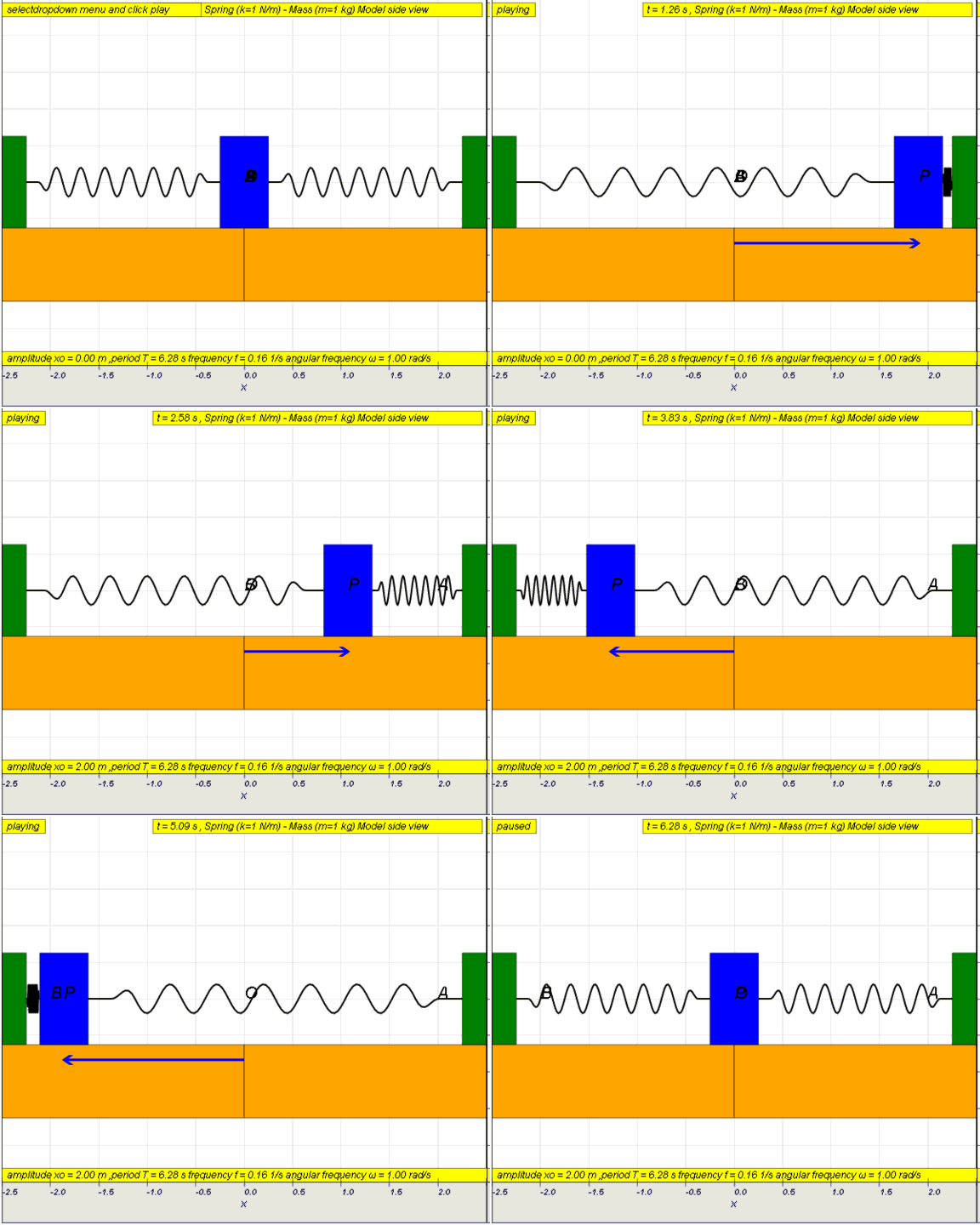
- Design and carry out an experiment to build a pendulum or spring-mass system to obtain a prescribed period. Present the experimental design, explaining the factors that determine the period of the oscillating system. This provides an opportunity for students to predict and collect data to ascertain the properties of a system and determine whether a motion is considered to be SHM. Students are also to understand that it is necessary for oscillations to be small for the motion to be considered as SHM. Students can also be shown other systems that demonstrate SHM . Simulations [1] [2] [3] , can also be used for students to investigate these factors.
- Investigate phase using a turntable or a simulation
- Investigate phase using a turntable or a simulation to associate each position in an SHM with a position on a uniform circular motion. This idea can be extended to the phase difference between different positions in an SHM. The association of SHM with uniform circular motion helps students to visualise many aspects of SHM. Students are to make mental links between three related ideas: physical position and velocity of the oscillator, angle in the associated uniform circular motion and the position of the oscillator on a displacement-time graph .
- Build a model for SHM using a datalogger or simulation
- Investigate the motion of a SHM system (pendulum, mass-spring system) using a datalogger or a simulation . Students are to practice observing the motion and interpreting graphs before getting into the mathematical details of the equations. Compare the relationship between the different variables particularly note the values of these valuables at equilibrium position and at endpoints. Students should practice converting one graph into another.
- Explore modelling of oscillation in molecules as SHM
- Explore how oscillations of molecules bounded by the van der Waals interaction can be SHM if the amplitude is small [4] .
- Explore benefits and danger of resonance
1. Simple examples of free oscillations LO(a)
1.1 YouTube of many examples of oscillators
http://youtu.be/VKtEzKcg6_s This video can be used at the start of the first lecture (while students settle down for lecture) to introduce oscillations, to show various modes of oscillations and to interest them.
1.1.1 Example 1: Simple pendulum

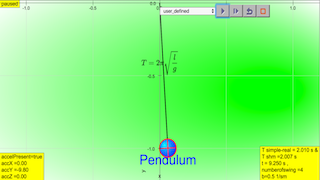
Static picture of a pendulum bob given an initial horizontal displacement and released to swing freely to produce to and fro motion
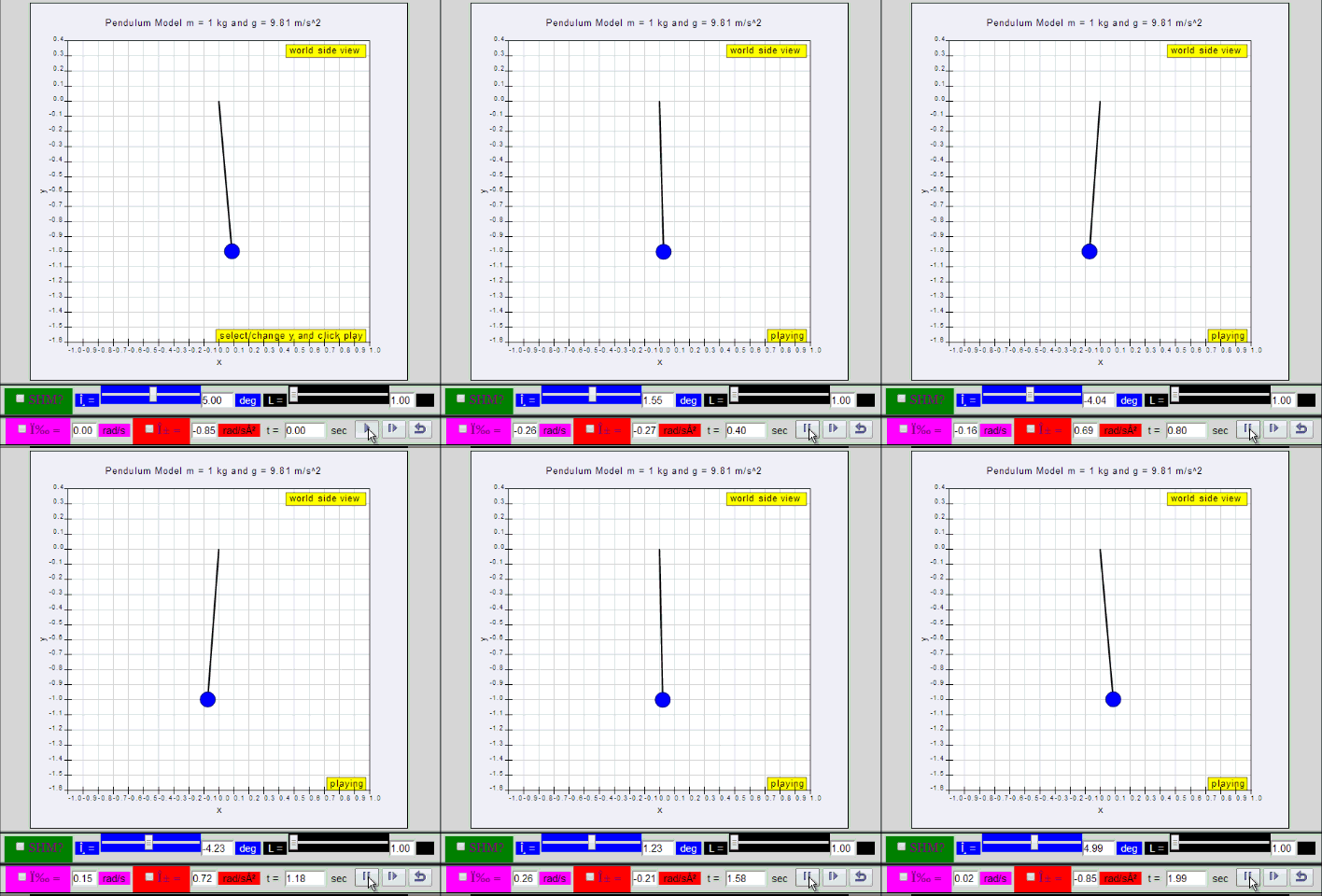
Dynamic picture of a pendulum bob given an initial horizontal displacement and released to swing freely to produce to and fro motion
1.1.2 Run Model:
1.1.2.Q1: what is the maximum angle of release before the motion is not accurately described as a simple harmonic motion for the case of a simple free pendulum?
1.1.2.A1: : 10 degrees for error of , depending on what is the error acceptable, small angle is typically about less than 10 degree of swing from the vertical.
Translations
| Code | Language | Translator | Run | |
|---|---|---|---|---|
 |
||||
Credits


 This email address is being protected from spambots. You need JavaScript enabled to view it.; Fu-Kwun Hwang; Francisco Esquembre; Wolfgang Christian; Félix J. García
Real Time Evo
🕰️
Briefing Document: Pendulum Toy and Real Time ODE 10 Pendulum JavaScript Model Simulation Applet HTML5
This briefing document summarizes the main themes, important ideas, and facts presented in the provided excerpts from "Pendulum Toy" and the "Real Time ODE 10 Pendulum JavaScript Model Simulation Applet HTML5" resource page.
Source 1: Pendulum Toy
- Title and Authors: Pendulum Toy, by This email address is being protected from spambots. You need JavaScript enabled to view it.; Fu-Kwun Hwang; Francisco Esquembre; Wolfgang Christian; Félix J. García.
- Licensing and Creation: Released under a Creative Commons Attribution license. Compiled with EJS 6.1 BETA (201115) in 2021.
Main Themes and Important Ideas:
- This source appears to be a software tool or simulation related to pendulum motion, created using Easy JavaScript Simulations (EJS).
- The mention of "Compiled with EJS 6.1 BETA" and the licensing information suggests a focus on providing an open and modifiable tool for exploring pendulum physics.
- The list of authors indicates a collaborative effort in developing this educational resource.
Source 2: Real Time ODE 10 Pendulum JavaScript Model Simulation Applet HTML5 - Open Educational Resources / Open Source Physics @ Singapore
- Platform and Purpose: This resource is part of the Open Educational Resources / Open Source Physics @ Singapore initiative. It provides an interactive JavaScript HTML5 applet simulating a pendulum using Real Time Ordinary Differential Equation (ODE) solving.
- Accessibility: The applet is designed to be embedded in webpages via an <iframe> tag and is compatible with various devices and operating systems, including desktops, laptops, tablets, and smartphones.
- Educational Focus: The page explicitly outlines guiding questions, learning outcomes, and suggested learning experiences related to simple harmonic motion (SHM), of which the simple pendulum, under certain conditions, is an example.
Main Themes and Important Ideas:
- Simple Harmonic Motion (SHM): A central theme, with guiding questions like "What are the characteristics of periodic motion? How can we study and describe such motion?" and "How do we analyse simple harmonic motion?".
- Pendulum as an Oscillator: The resource uses the pendulum as a primary example of a free oscillation, stating under "1.1.1 Example 1: Simple pendulum": "Static picture of a pendulum bob given an initial horizontal displacement and released to swing freely to produce to and fro motion Dynamic picture of a pendulum bob given an initial horizontal displacement and released to swing freely to produce to and fro motion".
- Learning Outcomes: The resource clearly defines what students should be able to do after engaging with it, including:
- Describing free oscillations.
- Investigating oscillator motion experimentally and graphically.
- Understanding and using terms like amplitude, period, frequency, and angular frequency.
- Recognizing and using the defining equation of SHM: "a = - ω2 x".
- Recalling and using the displacement equation: "x= x0 ω sin( ωt )".
- Understanding and using velocity equations: "v = v0 cos ( ω t ) , v = ± ω ( x 0 2 - x 2 )".
- Describing changes in displacement, velocity, and acceleration graphically during SHM.
- Describing energy interchange (kinetic and potential) in SHM.
- Understanding damped and forced oscillations, including resonance, with practical examples like car suspension systems.
- Graphically describing the amplitude of forced oscillations near the natural frequency and factors affecting resonance.
- Appreciating the uses and dangers of resonance.
- Learning Experiences: The resource suggests various activities for students, emphasizing both experimental and simulation-based learning:
- Examining different graphs representing SHM and understanding their interpretations.
- Designing and conducting experiments (or using simulations) to investigate factors affecting the period of oscillations, like a pendulum or spring-mass system. It notes that "it is necessary for oscillations to be small for the motion to be considered as SHM".
- Investigating phase using turntables or simulations, linking SHM to uniform circular motion.
- Building models for SHM using dataloggers or simulations, focusing on observing motion and interpreting graphs before mathematical details.
- Exploring the modeling of molecular oscillations as SHM (for small amplitudes).
- Exploring the benefits and dangers of resonance.
- Simulation and Interactivity: The inclusion of an embed code (<iframe width="100%" height="100%" src="https://iwant2study.org/lookangejss/02_newtonianmechanics_8oscillations/ejss_model_SHM01realtimeODE/SHM01_Simulation.xhtml " frameborder="0"></iframe>) highlights the interactive nature of the resource. Links to various simulations are also provided.
- Small Angle Approximation: The resource explicitly addresses the limitations of the simple harmonic motion model for a simple pendulum, stating in "1.1.2.A1": ": 10 degrees for error of , depending on what is the error acceptable, small angle is typically about less than 10 degree of swing from the vertical."
- Other Resources and Credits: The page includes links to external resources like GeoGebra and PhET simulations, along with credits to the developers, including those mentioned in the "Pendulum Toy" source, suggesting a shared development community or related projects.
Connections Between the Sources:
- Both sources are related to the study of pendulum motion.
- The "Pendulum Toy" likely represents one of the simulation tools that could be used as part of the "Learning Experiences" suggested in the "Real Time ODE 10 Pendulum JavaScript Model Simulation Applet HTML5" resource.
- The shared authors (Fu-Kwun Hwang, Francisco Esquembre, Wolfgang Christian, Félix J. García) strongly suggest a connected development effort within the Open Source Physics community. Both resources utilize Easy JavaScript Simulations (EJS).
Conclusion:
These resources provide valuable tools and pedagogical frameworks for understanding pendulum motion and its connection to simple harmonic motion. The "Pendulum Toy" appears to be a specific simulation tool, while the "Real Time ODE 10 Pendulum JavaScript Model Simulation Applet HTML5" page offers a broader educational context, including learning objectives, suggested activities, and links to various simulations (potentially including "Pendulum Toy" or similar tools). The emphasis on interactive simulations and open educational resources makes these valuable for both students and educators. The explicit mention of the small angle approximation for SHM in a simple pendulum is a key concept highlighted.
lution added to Prelim code of Evolution page
//shaun code
// Date.now() gets the current UNIX timestamp in milliseconds.
curTime = Date.now();
// prevTime is initialised when the play button is hit. dt measures the time passed between 2 consecutive steps
var dt = (curTime - prevTime) / 1000;
prevTime = curTime;
Apps

Other Resources
- https://www.geogebra.org/m/sux2Q5ak The Conical Pendulum by ukukuku
Press the play button. Watch the graph to see how the angle of the pendulum changes as it swings back and forth. Use the graph to determine the period of the pendulum. Adjust the scale by dragging the numbers on the axes. Change each variable – gravity, rod length, starting angle and mass – and observe how each one affects the period. Can you explain why? Try the damping slider. Does damping change the period?
Press the play button. Watch the graphs to see the motion of the spring pendulum. Can you distinguish the pattern of spring motion (up and down) from the pattern of pendulum motion (back and forth)? How are the two related? Is there a regular pattern to the motion? Compare the periods of the two graphs. How many different patterns can you produce by changing the variables – gravity, rod length, mass and spring constant? Under what conditions does the energy switch between back and forth and up and down? Does the initial starting angle affect the patterns when all the other variables are unchanged?
- http://www.walter-fendt.de/html5/phen/pendulum_en.htm
- http://physics.bu.edu/~duffy/HTML5/pendulum.html
- https://phet.colorado.edu/en/simulation/pendulum-lab
- http://www.thephysicsaviary.com/Physics/Programs/Labs/PendulumLab/index.html
Frequently Asked Questions about Pendulum Motion and Simple Harmonic Motion
1. What is periodic motion, and how does a pendulum exemplify it? Periodic motion is any motion that repeats itself at regular time intervals. A pendulum exhibits periodic motion as its bob swings back and forth, returning to its original position and direction of motion after a consistent period of time. This repetitive oscillation is a fundamental characteristic of periodic motion.
2. How is the motion of a simple pendulum related to Simple Harmonic Motion (SHM)? For small angles of displacement (typically less than 10 degrees from the vertical), the motion of a simple pendulum closely approximates Simple Harmonic Motion. SHM is a specific type of periodic motion where the restoring force is directly proportional to the displacement and acts in the opposite direction. In a simple pendulum with small oscillations, the component of gravity acting to restore the bob to its equilibrium position is approximately proportional to the displacement from that equilibrium.
3. What are the key properties used to describe Simple Harmonic Motion, such as that of a pendulum? Several key properties describe SHM:
- Amplitude (x₀): The maximum displacement from the equilibrium position. For a pendulum, this is the maximum angle or horizontal distance the bob reaches from its resting point.
- Period (T): The time taken for one complete oscillation (one full swing back and forth).
- Frequency (f): The number of oscillations per unit time, usually measured in Hertz (Hz). It is the inverse of the period (f = 1/T).
- Angular Frequency (ω): Related to the frequency by the equation ω = 2πf. It represents the rate of change of the angular displacement.
4. What factors affect the period of oscillation of a simple pendulum? The period of a simple pendulum depends primarily on two factors:
- Length of the pendulum (L): The period is directly proportional to the square root of the length. A longer pendulum will have a longer period.
- Acceleration due to gravity (g): The period is inversely proportional to the square root of the acceleration due to gravity. A pendulum will swing faster (shorter period) in a stronger gravitational field. Interestingly, for small oscillations, the mass of the pendulum bob and the initial angle of release (as long as it's within the small angle approximation) do not significantly affect the period. Damping forces, however, will eventually cause the oscillations to decrease in amplitude over time but ideally do not change the period.
5. How can we mathematically describe the displacement, velocity, and acceleration of a mass undergoing SHM, like a pendulum with small oscillations? The displacement (x) of a mass in SHM can be described as a sinusoidal function of time (t), such as x = x₀ cos(ωt + φ) or x = x₀ sin(ωt + φ), where φ is the phase constant. From this, we can derive expressions for velocity (v) and acceleration (a) by differentiation:
- Velocity (v): v = -ωx₀ sin(ωt + φ) or v = ω√(x₀² - x²)
- Acceleration (a): a = -ω²x This shows that the acceleration is always directed opposite to the displacement and is proportional to it, which is the defining characteristic of SHM.
6. How does energy transform during the Simple Harmonic Motion of a pendulum? During the oscillation of a simple pendulum (ignoring damping), there is a continuous interchange between potential energy (PE) and kinetic energy (KE). At the maximum displacement (amplitude), the pendulum momentarily stops, and all its energy is gravitational potential energy. As it swings towards the equilibrium position, the PE is converted into KE, reaching its maximum at the equilibrium point where the speed is highest and PE is minimum (ideally zero). As it swings towards the other extreme, KE is converted back into PE. The total mechanical energy (PE + KE) remains constant.
7. What is damping, and how does it affect the oscillations of a real pendulum? Damping refers to forces (such as air resistance and friction at the pivot point) that oppose the motion of an oscillator. In a real pendulum, damping causes the amplitude of the oscillations to gradually decrease over time until the pendulum eventually comes to rest at its equilibrium position. While ideally damping doesn't change the period of oscillation for small damping forces, significant damping can slightly affect it. Different degrees of damping exist, including underdamping (oscillations decrease gradually), critical damping (returns to equilibrium in the shortest time without oscillating), and overdamping (returns to equilibrium slowly without oscillating).
8. What are forced oscillations and resonance, and can they occur with a pendulum? A forced oscillation occurs when an external periodic force is applied to an oscillating system like a pendulum. The system will oscillate at the driving frequency of the external force. Resonance is a phenomenon that occurs when the driving frequency of the external force is close to the natural frequency of the oscillating system (the frequency at which it would oscillate freely). At resonance, the amplitude of the forced oscillations becomes very large, even if the driving force is relatively small. Resonance can occur with a pendulum if it is subjected to an external periodic force whose frequency is near its natural frequency, leading to a significant increase in its swing amplitude. Resonance can be both beneficial (e.g., in musical instruments) and detrimental (e.g., causing structural failure).
- Details
- Parent Category: 02 Newtonian Mechanics
- Category: 09 Oscillations
- Hits: 5387