
{source}
<?php require_once JPATH_SITE.'/TTcustom/TT_contentparser.php';//include 'TT_contentparser.php';\(parameters = array( "topicname" => "00workshop/2015DouglasWolfgang", //e.g. 02_newtonianmechanics_2kinematics "modelname" => "Rateofchangedeclelerationtillstop_bicycle_modelledwithconstantspeed"); //e.g. airpuckconstantvelocity.trzecho generateSimHTML(\)parameters, "TRZ");
?>
{/source}
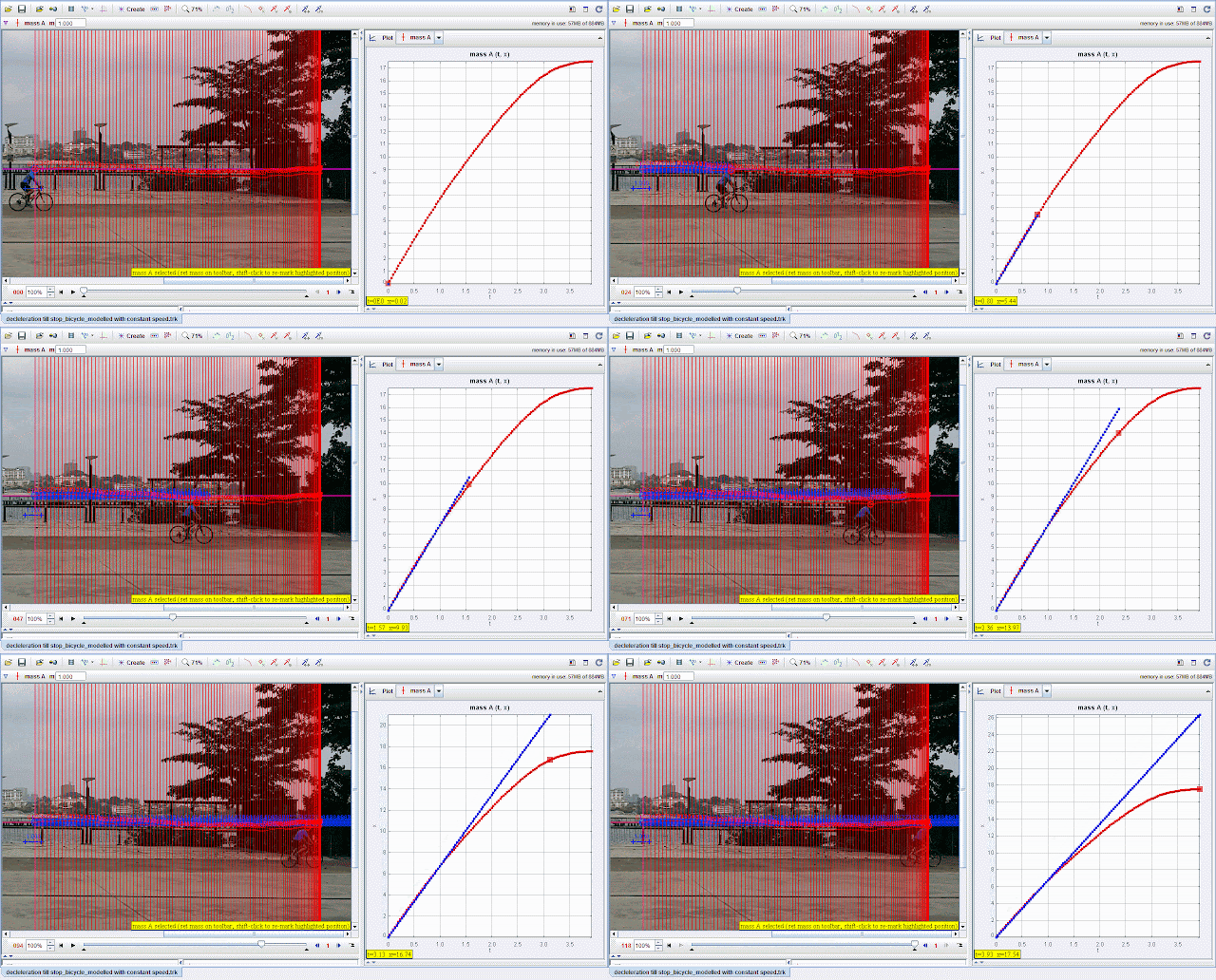
Document Brief: Title: "Tracker Rate of Change Decelerating Bicycles with Model by Evergreen Sec Tan Kim Kia"
This document investigates the deceleration of bicycles, analyzing the rate of change of velocity and the factors contributing to the reduction in speed. Using a model, the dynamics of deceleration are visualized and understood through graphical and numerical analysis.
Study Guide:
Objective: Examine the deceleration of bicycles to understand the relationship between force, mass, and rate of change of velocity.
Key Concepts:
-
Deceleration:
-
Negative acceleration indicating a reduction in velocity over time.
-
-
Newton’s Second Law of Motion:
-
, where a negative force (braking or resistance) results in deceleration.
-
-
Force Opposing Motion:
-
Braking force, air resistance, and friction contribute to the reduction in speed.
-
-
Velocity-Time Graphs:
-
Useful for analyzing deceleration rates by observing the slope.
-
Experiment Overview:
-
Setup: Bicycles are tracked as they decelerate under controlled conditions, such as braking on a flat surface. Motion data is captured using a video tracker or speed sensors.
-
Procedure:
-
Record velocity and time as the bicycles come to a stop.
-
Plot velocity-time graphs to determine deceleration rates.
-
Compare deceleration under different braking forces or surface conditions.
-
-
Observation Points:
-
Slope of the velocity-time graph (indicates the rate of deceleration).
-
Time taken to come to a stop.
-
Questions to Consider:
-
How does braking force affect deceleration?
-
Answer: Greater braking force results in higher deceleration rates, leading to shorter stopping distances.
-
-
What role does surface condition play in deceleration?
-
Answer: Rough or high-friction surfaces enhance deceleration, while smooth or wet surfaces reduce it, increasing stopping distances.
-
-
How is deceleration calculated from velocity-time data?
-
Answer: Deceleration is the slope of the velocity-time graph and is calculated as , where is the change in velocity and is the time interval.
-
Applications:
-
Understanding braking dynamics in vehicles and bicycles.
-
Designing safer braking systems and optimizing stopping distances.
-
Teaching principles of motion and forces in educational settings.
FAQ:
-
What is deceleration? Deceleration is negative acceleration, where an object slows down over time.
-
How is deceleration visualized? By plotting a velocity-time graph; a downward slope represents deceleration.
-
Why does friction aid in stopping? Friction opposes motion and helps convert kinetic energy into heat, reducing velocity.
-
What factors affect stopping distance? Stopping distance is influenced by speed, braking force, mass, and surface condition.
-
Can this analysis apply to other vehicles? Yes, the principles of deceleration are universal and apply to all modes of transportation.