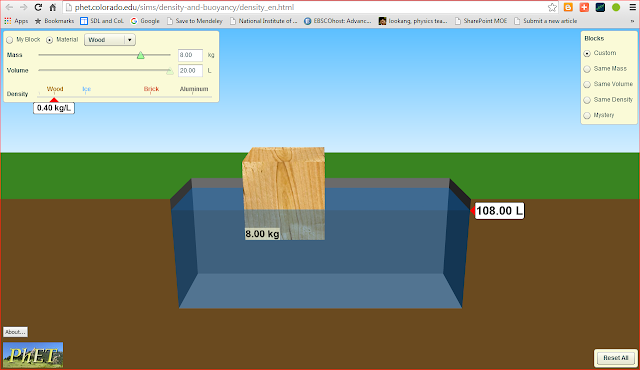
https://phet.colorado.edu/en/simulations/density

Briefing Document: Density Flash Applet & OER Physics @ Singapore
1. Overview
This document provides a review of the "Density Flash Applet" by PhET, hosted on the "Open Educational Resources / Open Source Physics @ Singapore" website. This website serves as a repository for interactive physics resources, primarily simulations and applets designed for educational use. The Density Flash Applet, in particular, is a tool for learning about the relationship between mass, volume, and density.
2. Key Themes and Ideas
- Interactive Learning: The core of the provided material revolves around the use of interactive simulations to teach physics concepts. The Density Flash Applet is presented as a hands-on tool where students can actively manipulate variables and observe their effects.
- Focus on Density: The applet itself is centered on the concept of density. It encourages users to explore how changes in mass and volume affect an object's density. It moves beyond simple definitions and encourages discovery of the relationship.
- Inquiry-Based Approach: The learning goals and activities associated with the applet are designed to foster inquiry-based learning. Students are encouraged to "derive the formula to calculate density" rather than simply being told it.
- Real-World Application: The learning goals also explicitly link the concept of density to real-world applications, mentioning examples like "ships travelling on the sea and hot air balloons."
- Virtual Experimentation: Teachers are encouraged to use the applet for virtual experiments, such as the example of determining the material of a gold wreath.
- Open Educational Resources: The entire context of the applet is framed by the concept of Open Educational Resources (OER). The platform itself hosts numerous interactive models that are made available for educational use. The mention of a Creative Commons license further reinforces the openness of the resources.
- Multimedia Presentations: The material encourages students to present their findings in a "multimedia presentation," implying the combination of simulations, data, and communication of analysis for greater impact.
- Wide Array of Resources: The listing of various other applets and resources alongside the Density Flash Applet highlights the breadth of content available on the website which goes well beyond a single physics concept. This suggests a comprehensive approach to physics education through interactive digital resources.
Density Study Guide
Quiz
Instructions: Answer each question in 2-3 complete sentences.
- What is density and how is it related to mass and volume?
- According to the Density Flash Applet, how can you measure the volume of an irregular object?
- What does the applet suggest about objects with similar mass but different volumes?
- How does the applet demonstrate the relationship between changing an object’s mass or volume and its density?
- What are two real-world applications of density, according to the applet's learning goals?
- What is the formula for calculating density using mass and volume?
- How does the applet enable users to "identify mystery objects"?
- What is the primary task for students using the applet, as described in the "For Teachers" section?
- What are the software requirements for running the Density Flash Applet?
- Name at least three topics that can be explored using simulations provided by the Open Educational Resources / Open Source Physics @ Singapore website.
Quiz Answer Key
- Density is a measure of how much mass is contained in a given volume; it is calculated as mass divided by volume. It describes how tightly packed the matter is within an object.
- According to the applet, you can measure the volume of an irregular object by observing how much fluid it displaces when submerged. This allows the user to determine the volume even if it's not a simple geometric shape.
- The applet demonstrates that objects with similar mass can have differing volumes, meaning they will have different densities. This illustrates that density is a property distinct from mass and volume and is determined by the relationship between the two.
- The applet shows that changing an object’s mass or volume, if done proportionally, does not affect its density. This is because density is an intensive property—it is a characteristic of the material itself, not the amount of material present.
- The applet cites ships traveling on the sea and hot air balloons as real-world applications of density. These examples demonstrate that objects will float or sink depending on their overall density compared to the surrounding fluid.
- The formula for calculating density is density = mass / volume or ρ = m/V where ρ is density, m is mass, and V is volume.
- Users can identify mystery objects by calculating their densities using the mass and volume tools within the applet, then comparing the derived values to a table of known densities of different materials.
- The primary task for students is to conduct a virtual experiment to determine if a gold wreath is made of pure gold. This involves measuring mass and volume, calculating density, and using this result to draw a conclusion.
- The Density Flash Applet requires Macromedia Flash 9 or later and can be run on Windows (XP/Vista/7), Macintosh (OS 10.5 or later), and Linux systems.
- The Open Educational Resources / Open Source Physics @ Singapore website offers simulations to explore diverse topics, including: Newtonian mechanics, gravity, motion, harmonic oscillations, electromagnetism, and the behavior of gases.
Essay Questions
- Explain the concept of density as an intensive property, and discuss how the Density Flash Applet can help students grasp this concept by experimenting with different objects.
- Discuss how the Density Flash Applet can be used in a classroom setting to develop critical thinking and problem-solving skills among students. How could a teacher effectively structure a lesson using the applet?
- Compare and contrast the concepts of mass, volume, and density, explaining how they are related and distinct. Provide real-world examples of how each concept manifests.
- Describe how simulations like the Density Flash Applet can enhance physics education compared to traditional methods of teaching. In what ways is the interactive approach more useful?
- The website offers a vast range of simulations on various physics topics. Choose three different simulations (besides the Density Flash Applet), and describe how each could be used in a high school physics curriculum.
Glossary of Key Terms
Density: The measure of how much mass is contained in a given volume; calculated as mass divided by volume. It is a property of a material that describes how tightly packed its matter is.
Mass: A measure of the amount of matter in an object. It is a fundamental property of an object and does not change unless matter is added or removed.
Volume: The amount of space that an object occupies. Volume can be measured in cubic units, such as cubic centimeters (cm³) or cubic meters (m³), or units of capacity such as liters.
Intensive Property: A property of a substance that does not depend on the amount of the substance present. Examples include density, melting point, and boiling point.
Displacement: The process of a fluid being pushed aside by an object placed in it. The volume of fluid displaced is equal to the volume of the submerged portion of the object.
Simulation: A computer-based model designed to replicate a real-world or hypothetical process, often used for educational or experimental purposes.
About
http://phet.colorado.edu/sims/density-and-buoyancy/density_en.html
Topics
- Density
- Mass
- Volume
Description
Why do objects like wood float in water? Does it depend on size? Create a custom object to explore the effects of mass and volume on density. Can you discover the relationship? Use the scale to measure the mass of an object, then hold the object under water to measure its volume. Can you identify all the mystery objects?
Sample Learning Goals
- Derive the formula to calculate density from their understanding of mass and volume
- Use the formula to determine density, mass and volume
- Describe some applications of density in real life, such as ships travelling on the sea and hot air balloons.Describe how the concept of density relates to an object's mass and volume.
- Explain how objects of similar mass can have differing volume, and how objects of similar volume can have differing mass.
- Explain why changing an object's mass or volume does not affect its density (ie, understand density as an intensive property).
- Measure the volume of an object by observing the amount of fluid it displaces.
- Identify an unknown material by calculating its density and comparing to a table of known densities.
For Teachers
Get students to complete a density investigative project by conducting a virtual experiment to determine whether a gold wreath is made of pure gold. They are tasked to complete a multimedia presentation based on what they have experimented and submit online.
http://weelookang.blogspot.sg/2015/12/density-flash-applet-by-phet.html
Software Requirements
| Windows | Macintosh | Linux |
|---|---|---|
|
Microsoft Windows
XP/Vista/7
Macromedia Flash 9 or later
|
OS 10.5 or later
Macromedia Flash 9 or later
|
Macromedia Flash 9 or later |
Credits
[SIMU_CREDITS]
Design TeamThird-party LibrariesThanks To
- Wendy Adams
- Kelly Lancaster (lead)
- Trish Loeblein
- Chris Malley
- Jonathan Olson (developer)
- Archie Paulson
- Kathy Perkins
- Noah Podolefsky
- Sam Reid (developer)
- Carl Wieman
- Away3D
- Box2D
Other Resources
- https://www.geogebra.org/m/uM5fD5KD Buoyancy by ukukuku
Frequently Asked Questions About Density
- What is density and how is it calculated? Density is a measure of how much mass is contained in a given volume. It describes how tightly packed the matter in an object is. Density is calculated by dividing the mass of an object by its volume. The formula is often written as: Density = Mass / Volume. For example, if a rock has a mass of 100 grams and a volume of 50 cubic centimeters, its density is 2 grams per cubic centimeter (100g/50 cm³ = 2 g/cm³).
- How do mass and volume affect an object's density? Density is directly proportional to mass and inversely proportional to volume. This means that:
- If you increase the mass of an object, without changing its volume, its density will increase.
- If you increase the volume of an object, without changing its mass, its density will decrease.
- Density will remain the same if you increase the mass and the volume by the same proportion.
- Why do some objects float while others sink? Whether an object floats or sinks depends on its density compared to the density of the fluid it is placed in. If an object is less dense than the fluid (e.g., wood in water), it will float. If an object is denser than the fluid (e.g., a rock in water), it will sink. Objects will also float if its bouyant force is equal or greater than it's weight. This buoyant force is equal to the weight of the fluid displaced by the object.
- Does the size of an object affect its density? No, the size of an object does not affect its density. Density is an intensive property, which means it is a characteristic of the material itself and not dependent on the amount of the substance present. If you have a small piece of gold and a large gold bar, both have the same density. Similarly, a small block of wood and large log will have the same density if they are of the same type of wood.
- How can I measure the volume of an irregularly shaped object? For objects with irregular shapes, it can be difficult to calculate their volume using standard formulas. A common method to measure the volume of an irregular object is to use the fluid displacement method. You submerge the object in a container of fluid (like water) and measure the volume of the fluid displaced. The volume of the displaced fluid is equal to the volume of the object.
- How can the concept of density be applied in real-life scenarios? Density has numerous applications in everyday life. Some examples include:
- Ships: Ships are made of materials denser than water, but their overall shape and structure allow them to displace a large volume of water. When the weight of this displaced water equals the weight of the ship, it floats.
- Hot Air Balloons: Hot air is less dense than cold air. Heating the air inside a balloon makes it less dense than the surrounding air, causing the balloon to rise.
- Material Identification: Density can be used to identify unknown materials by comparing their density to the densities of known substances.
- Construction: Understanding density helps engineers select appropriate materials to construct stable buildings and infrastructure.
- How can this applet help in learning about density? The "Density Flash Applet" allows users to create custom objects and explore the effects of mass and volume on density. Using the scale to measure mass and the water immersion technique to measure volume, students can empirically derive the formula for density and determine the density of mystery objects using provided data. It encourages hands-on learning and investigation in a virtual environment. This includes allowing students to understand how mass and volume interact to influence density and also what buoyant forces are involved.
- What kinds of activities or projects can be done using this applet? The applet can be used for a variety of activities and projects. One example would be a virtual investigative project where students need to determine whether a gold wreath is made of pure gold. This is done by measuring the mass and volume of the object to calculate its density, and comparing to known densities of gold. They can then produce a multimedia presentation of the experimental findings to be submitted online.